NEWS
Impossible to overlook: Reflections on the High VisAbility project
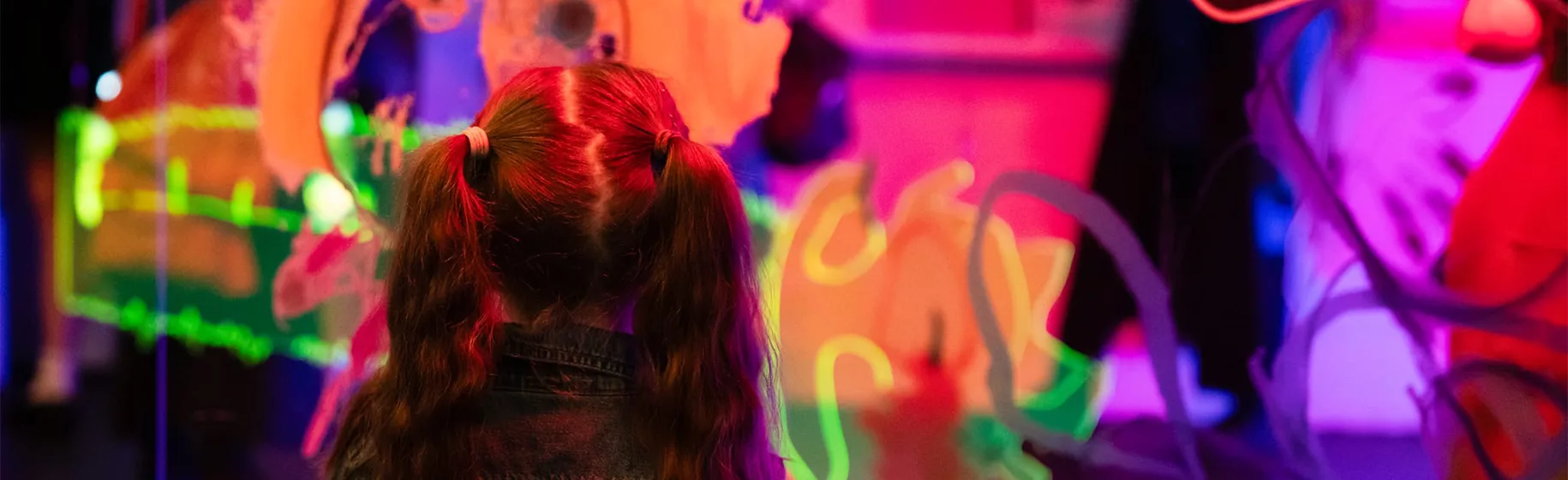
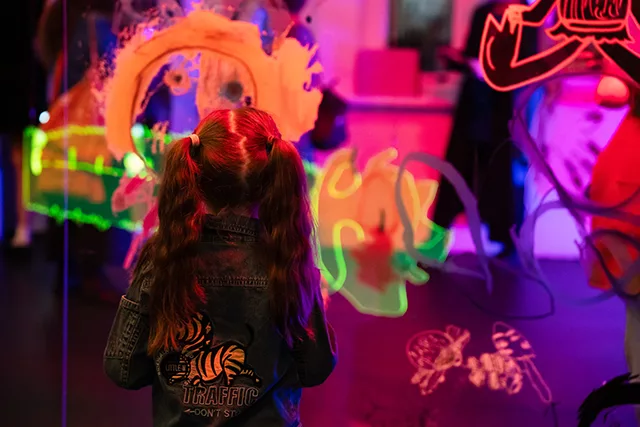
Western Australian artist, freelance writer and curator Andrew Nicholls reflects on the impact and beauty of High VisAbility, a project that illuminates pathways into the arts for young people with disabilities.
Unlike conventional pigments that have been employed by humans for artistic expression for millennia, fluorescent colours are a relatively recent invention, first observed by Western science in the 16th Century and not named until the 19th. Their luminosity derives from utilising a broader range of both visible and invisible light than other colours: whereas conventional hues reflect up to 90% of the light spectrum, fluorescents can reflect up to 300%. In other words, they work harder than other colours to draw our attention.
The eye-catching impact of fluorescent colour is frequently employed by Mandy White, a self-identified “outsider” artist who nonetheless habitually crosses into the mainstream of the contemporary art world. White is beloved by audiences for her vibrant and playful paintings, sculptures and works on paper, which frequently utilise attention-grabbing fluorescents and glitter. Sometimes drawing on her Yamatji heritage, White’s works express an animistic world view, depicting a diverse range of often humorous and occasionally-sinister animals and spirit beings on highly gestural backgrounds. Her deft eye for colour and composition, skilled linework and sharp wit see her regularly shortlisted for (and winning) major awards and curated into important exhibitions and art fairs in Western Australia and internationally.
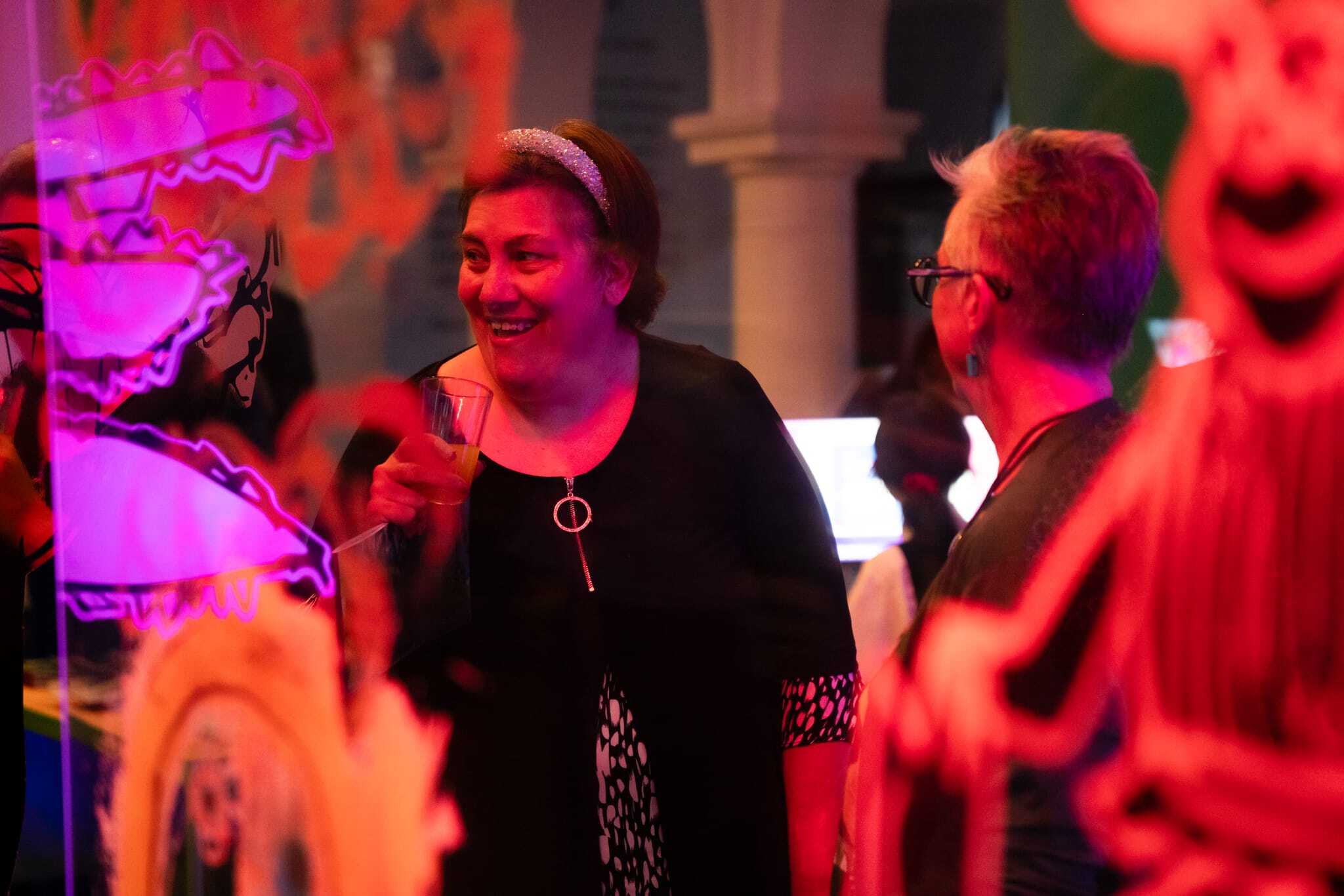
Mandy White, a self-identified 'outsider' artist who nonetheless habitually crosses into the mainstream of the contemporary art world. Mandy is pictured here at the opening of 'High VisAbility' at PICA.
Alongside her highly accomplished art practice White is a skilled facilitator and a role model to other artists living with disability, and the High VisAbility project has allowed her to inspire and collaborate with a diverse cohort of around 50 differently-abled young people from Sir David Brand School over several months during 2024. Devised by Community Arts Network as a partnership with the School and Awesome Arts, the project was a group effort, delivered by a formidable team, but stridently led by White (supported by co-lead artist Natalie Scholtz), with key aesthetic decisions inspired by her sensibility, and a flexible and responsive structure driven by her insistence that the students’ artistic vision always remain central. The project title alludes to White’s trademark love of fluoro colours, but is also a call to action, in amplifying the creativity of people who are frequently relegated to the sidelines of culture.
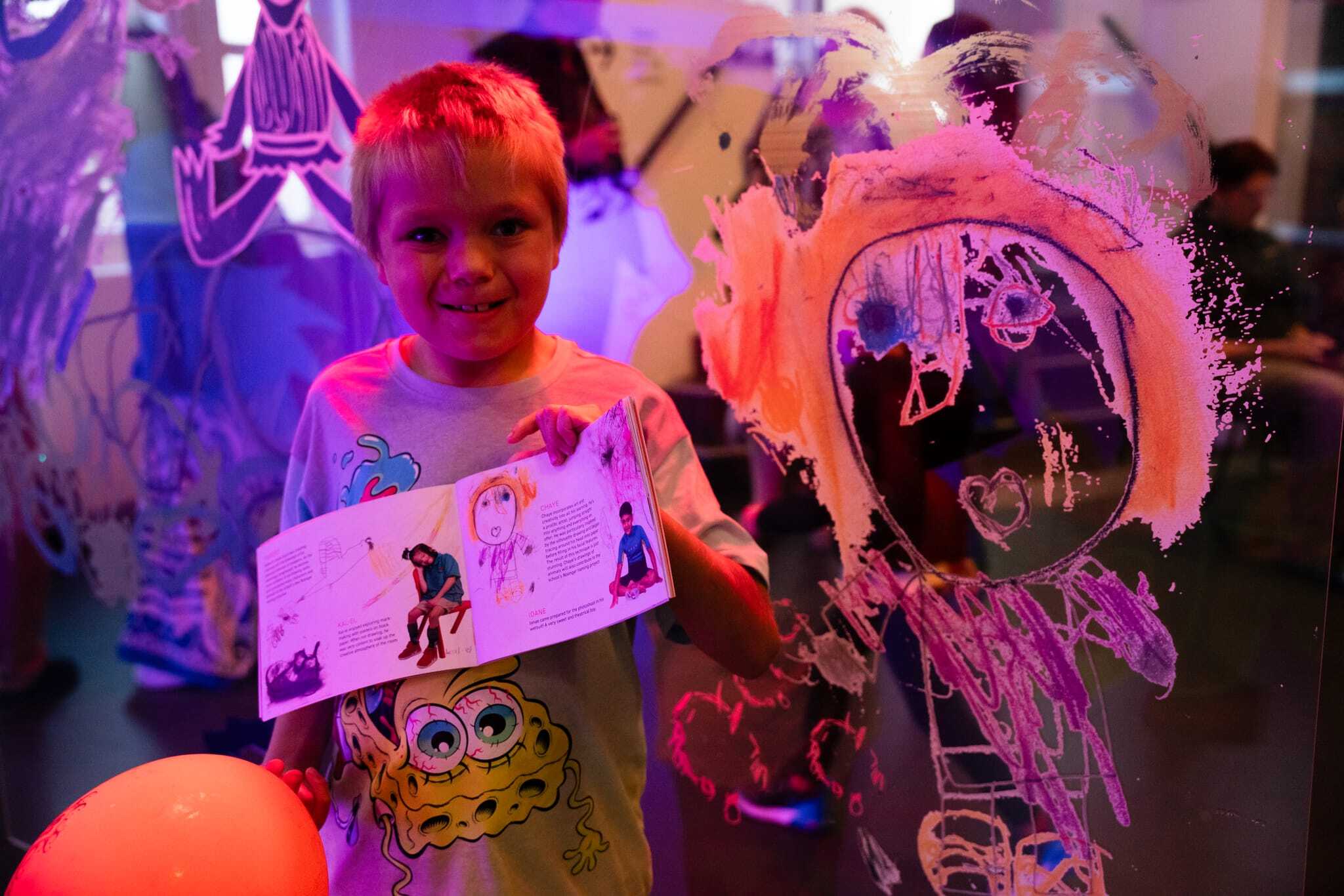
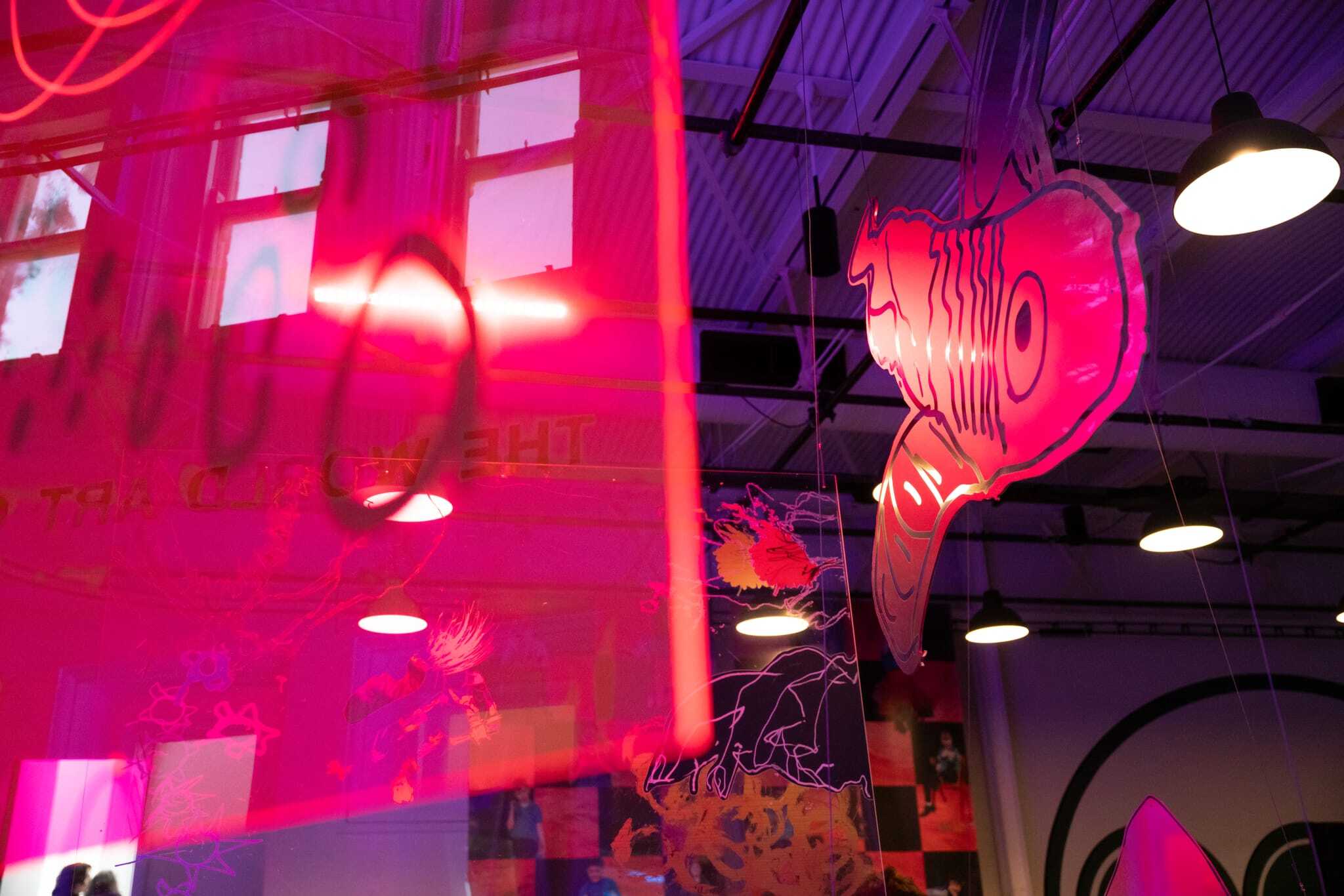
High VisAbility has particularly done this by focusing on ambitious works of scale capable of providing the participating students (and audiences alike) with immersive experiences. Three of these were launched at the first showcasing of project outcomes at the Perth Institute of Contemporary Arts in late 2024. This included a hanging installation translating drawings by White and the students into heroic scale, which exploits the translucency and neon-like qualities of fluorescent Perspex to create a space for playful exploration. This work was complemented by enormous, printed banners showcasing portraits created collaboratively by the students and guest mentor, photographer Christophe Canato. Multiple drawings by various participants were also expertly animated by student Raphael with mentorship from animator Jake Carlshausen, reinforcing the collaborative approach that has marked the project: throughout the development of High VisAbility, outcomes have been freely shared, reworked and reinterpreted by different members of the cohort, indicating the level of trust cultivated by White and her team.
Edwin Sitt
Chaye, one of the student artists from Sir David Brand School, with the hanging perspex installation which translates drawings by White and the students into heroic scale, at the opening of 'High VisAbility' at PICA.
The second exhibition of project outcomes at FORM Gallery has furthered this collective approach via a group assemblage by White and several established “outsider” artists in her network, an initiative designed to highlight the career paths that exist, should the students wish to continue their artmaking into adulthood. Alongside solo works by several students and collaborative interpretations of local flora and fauna inspired by Noongar Traditional Owner Geri Hayden, the exhibition at FORM Gallery additionally showcases a spectacular series of large-scale works on paper. These highly sophisticated collaborative compositions exist in stark contrast to the whimsical aesthetic one might expect from student artists. Though White’s trademark fluoro oranges and pinks are present, the series overall has an almost sombre, distinctively corporeal messiness. It comprises mark-making from every project participant (including those with extremely limited mobility), built up through months of layering with hands, feet and tools, with White responsible for resolving each composition in her studio, moulding them into a strikingly cohesive and resonant body of works.
High VisAbility was conceived for and by creatives with differing levels of ability, and it has more than delivered on its ambition to place marginalised voices at the centre of artistic discourse. The resulting works are particularly inspiring in the context of an art world where conversations are increasingly taking place (though not enough of them, and not yet loudly enough) regarding the industry’s able-centric nature and the lack of safety for marginalised artists, art workers and audiences (be that based on ability, ethnicity, culture, age, gender, sexuality or any combination of these) in a sector that loudly claims to be progressive and inclusive, while frequently providing only the barest-minimum requirements for participation. The sophistication of the High VisAbility works and their scale of ambition evidences the richness that can be achieved by making the effort to build accessibility into all levels of a project from the outset, while their collaborative nature shatters the Modernist cliché of the artist as solitary hero, in favour of an egalitarian sharing of the spotlight, and a spirit of playful generosity.
Edwin Sitt
Like fluorescents which work harder than other colours to draw the eye, White and her collaborators have laboured tirelessly to create a body of work that is impossible to overlook.
In White’s home state of Western Australia, “hi-vis” is synonymous with the mining industry and other forms of manual labour in which attention-grabbing colour contributes to safe work practice. While this association is unavoidable in a culture so dominated by the economic and environmental impact of the resources industry, it makes for a surprisingly appropriate point of reference, evoking several themes that are central to the High VisAbility project: the fallibility of the body (hi-vis is primarily designed to keep people physically safe) in the context of a project focused on differing levels of ability; protection, with the entire project designed to ensure a safe space; group endeavour (seldom will someone in high-vis be working alone), reflecting the project’s “safety in numbers” approach; and most importantly, the notion of hard work, which in this case has resulted in creative outcomes of impressive sophistication and scale. Like fluorescents which work harder than other colours to draw the eye, White and her collaborators have laboured tirelessly to create a body of work that is impossible to overlook.
High VisAbility is showing 15 January - 8 February 2025 at FORM Gallery, 4 Shenton Road, Claremont.


Monday – Friday, 9am – 5pm
PO Box 7514 Cloisters Square WA 6850
King Street Arts Centre
Ground Floor
357–365 Murray Street
Perth WA 6000
08 9226 2422
admin@can.org.au
ABN: 72106364407
Copyright 2026 CAN