NEWS
Artwork honours Elders' lives and stories
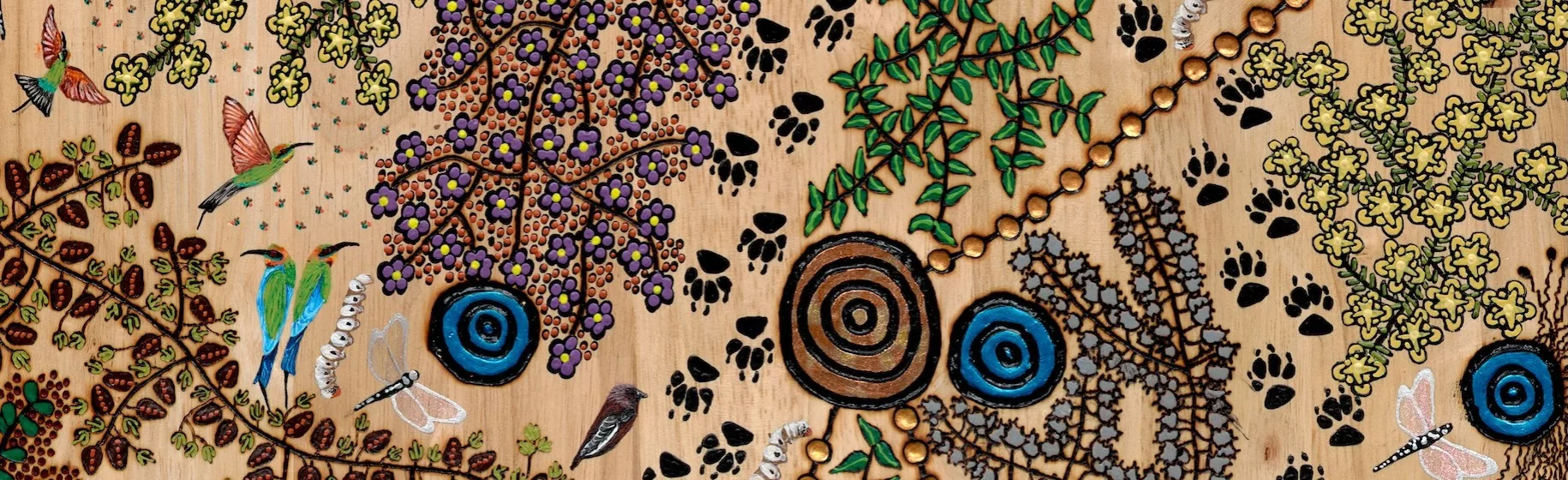
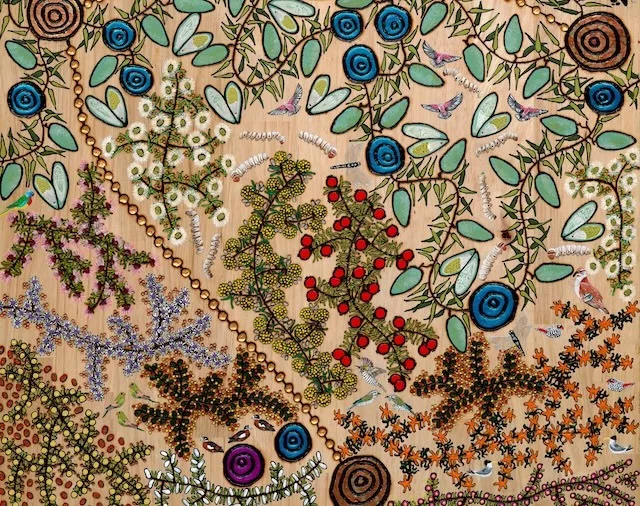
Tina is renowned for her intricate depictions of plants, animals and bush foods and her exquisite use of pyrography – burning motifs into wood. The more you look at Karlkurla Ngurra Wangka, the more you find – it’s such a delight and we are so honoured to have Tina’s art in the upcoming Legacies Karlkurla (Kalgoorlie) exhibition at the Museum of the Goldfields, 28 February - 3 May.
"This artwork honours our senior Elders who have come together to share their stories. They have inherited and earned the right to knowledge – our cultural safekeepers," says Tina.
"The karlkurla is dominant as it represents the Country we are on. The circles represent each Elder who kapurturri (come together) to share their unique journey through history."
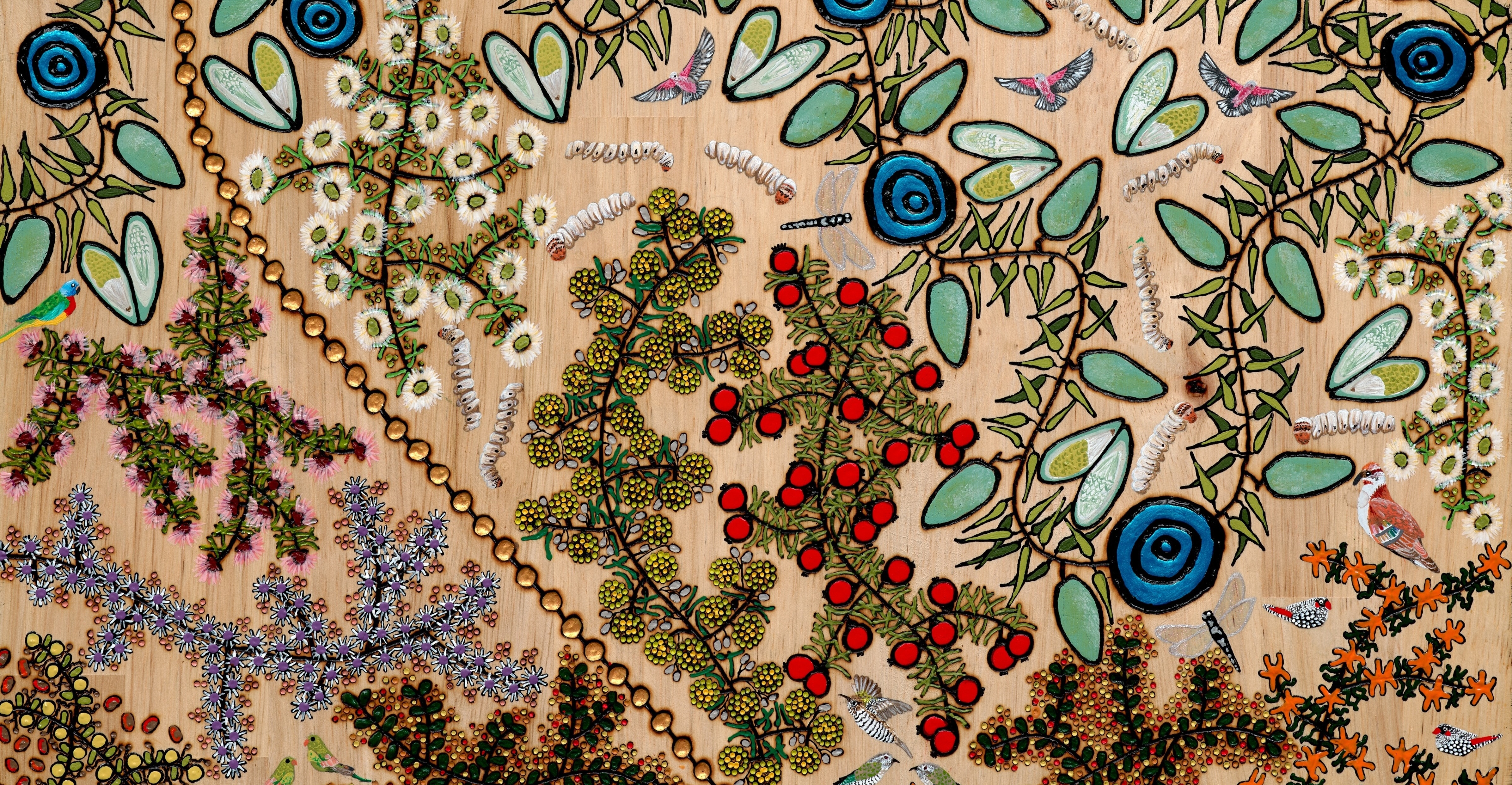
Tina Carmody
The more you look at this work, the more you find – a detail from Tina Carmody's work reveals some of the many plants and animals she has depicted.
"Each leaf, flower and creature featured in Karlkurla Ngurra Wangka is connected to Silky Pear Country, and the Elders' connection to that land.
"The karlkurla (silky pear) fruit and vines represent Country (Ngurra). The Pila (Spinifex) people call this Country Karlkurlatjarraku – the land where the karlkurla grows. The karlkurla vine weaves through other plants producing fruits of identity.
"The golden circles represent the location of each Elder’s birthplace (kankjuwiltja). The travel lines (ngara) represent the Elders coming together to speak on Silky Pear Country (Karlkurla Ngurra Wangka Kapurturri). The Elders come from different nations of people throughout the Goldfields region but they are socially and culturally connected to Karlkurla Ngurra (Kalgoorlie Country/home).
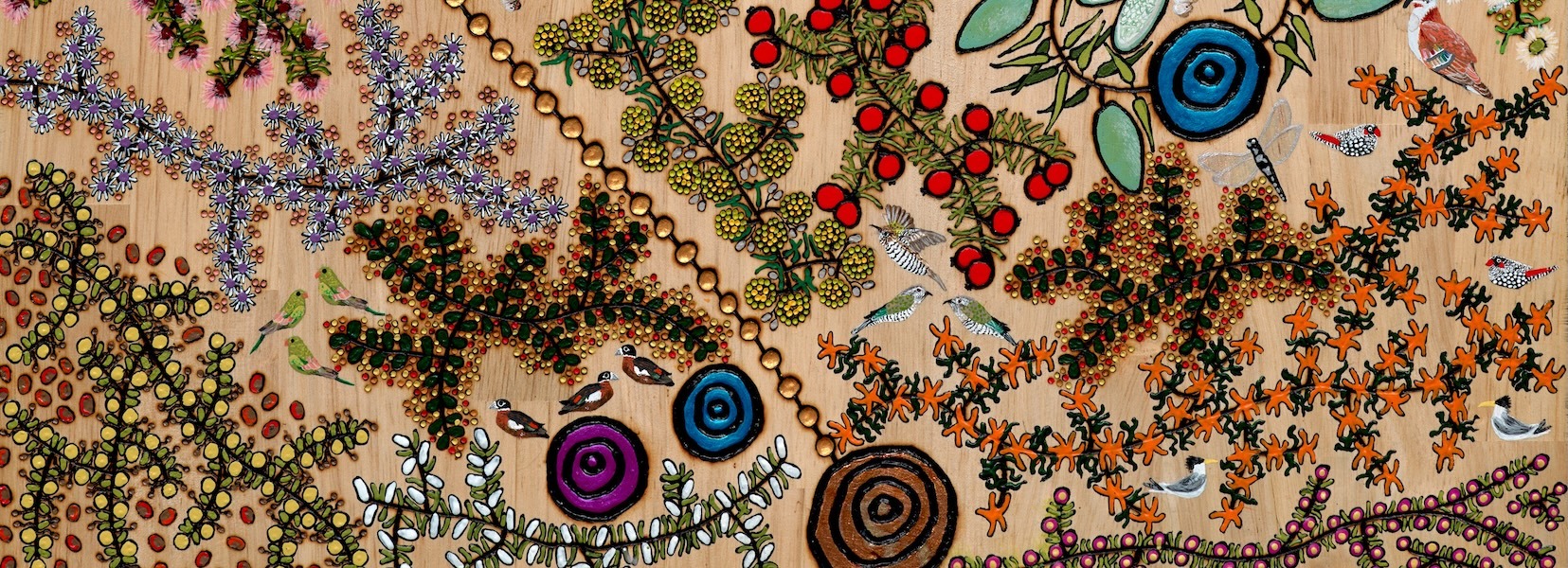
Tina Carmody
Another detail revealing the kaleidoscope of flora and fauna featured in Tina's work.
"The desert landscape in the Goldfields region is pristine and its arid wilderness includes orange/red sand dunes (ngali), stony plains and dry salt lakes. Rockholes (kapi tjarlu) are scarce and only hold water during wet periods.
"The Country is littered with yellow wattle, cream flowering salmon gum, other pink and red flowering eucalyptus gums, small red bush plum (arrngurli), quondong (wayarnu), orange bush tomato (tjuntawara), yellow pigweed flowers (wakati), bush onion (tjanmarta), kurrajong pods (ngalta), desert poplar (kalurti), saltbush (puntaru) and many other types of edible vegetation (mayi). The pukura shrub flowers in white, pink and mauve to red. It grows in sand hill country and when the early morning sun hits beads of dew, it drips sweet water – bush cordial.
"Living within this shifting-desert-sands kaleidoscope – with its secret food sources – are a variety of animals, such as the Spinifex (Pila) and Nullarbor bronzewing pigeons (ngatapuka), pink and grey galah (kinturrka), zebra finch (nyii-nyii), rainbow bee eater (tirru-tirru), black faced swallow (tirun-tirunpa), crested bell bird (parn-parnparlarla) and budgie (kily-kilykarri), all coexisting together sharing food sources. Maku (bardi grubs) stay hidden under tree bark and honeyants (tjala) prefer the coolness of the underground. Dingo (papa) paws imprint the sands under cold weather clouds (talykarra).
"Karlkurla Ngurra Wangka honours our Elder’s legacies through birthplace, travel lines and all living beings that contribute to the identity of Elders and their legacies."
The images on this page are close-up details from Tina Carmody's Karlkurla Ngurra Wangka (Speaking on Silky Pear Country). If you're in Kalgoorlie you'll be able to see the entirety of this beautiful work at the Museum of the Goldfields, 28 February – 3 May.


Monday – Friday, 9am – 5pm
PO Box 7514 Cloisters Square WA 6850
King Street Arts Centre
Ground Floor
357–365 Murray Street
Perth WA 6000
08 9226 2422
admin@can.org.au
ABN: 72106364407
Copyright 2026 CAN