Hillview Community Mural
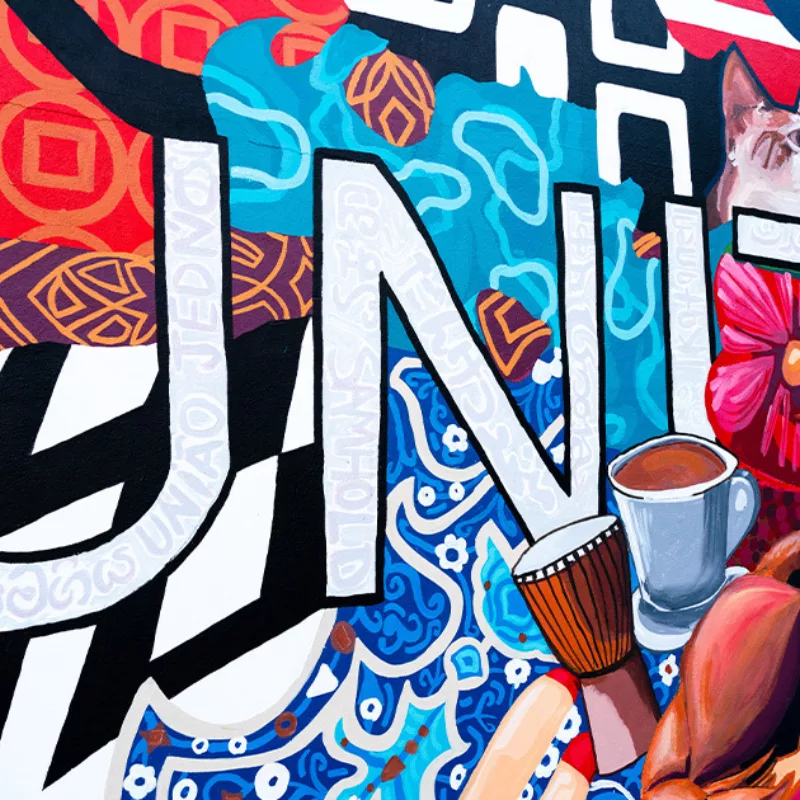
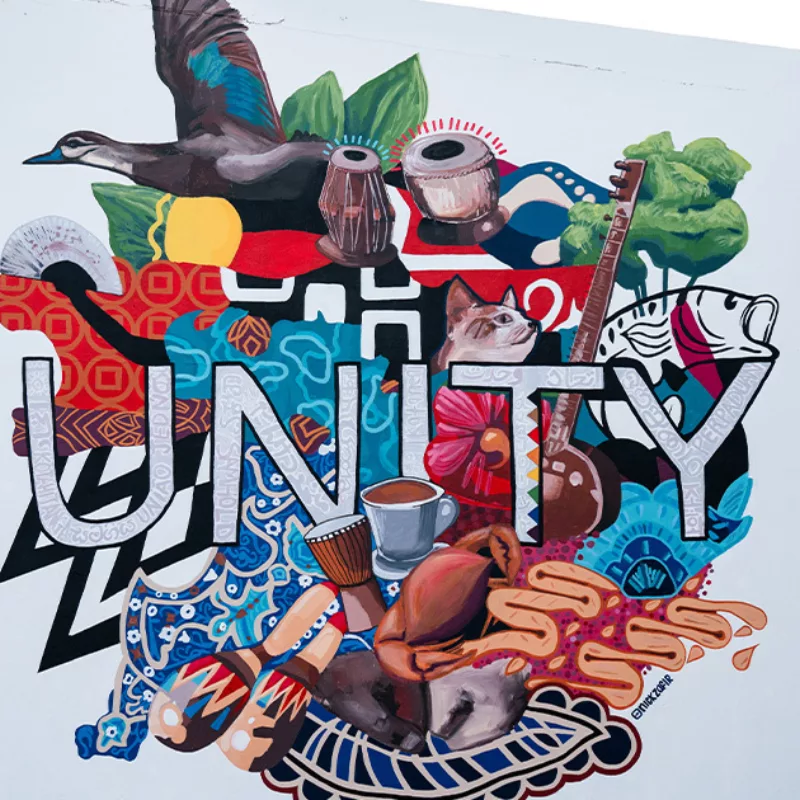
This artwork aims to celebrate the difference, diverse backgrounds and intercultural connections between communities of the Hillview Intercultural Community Centre.
We developed the idea of a collage through a collaborative design process with community; using recognised patterns from various cultures and elements of “home” to create one overarching sentiment of welcoming and unity.
Translations of the word unity in different languages are embedded within the text UNITY and reflect the many interpretations and contexts we bring to an intercultural space.
Watch the video to learn more about the process and participants involved in the Hillview Community Art Project.
Click here to listen to the audio description of the artwork. Participant Wildaliz De Jesús is a person with a disability and offered to write and record this description.
Mural Gallery
Project Team
Lead Artist: Nick Zaffir
CAN Team: Lidia Castro, Shenali Perera
City of Canning Team: Meagan Price, Gauri Thanasingham, Rosemine Mutamuliza
Thank you to all the Cultural Ambassadors and community members who contributed to UNITY through their involvement in the design and painting workshops, held at Hillview Intercultural Community Centre during May 2023 and facilitated by Community Arts Network.
Community Participants:
| Santosh Amasi Danielle Anataki Javeria Atif Siddiqui Lisa Brandis Lidia Castro Adeline Cheong Eu En Chong Khoza Chulu Wildaliz De Jesús Natalie de Rozario Shruti Diwan | Amit Mehta Sidro Abdirazak Mohamed Shane Morrison Syed Muzaffar Ahmed |
Supported By:

Perhaps the feature that may grab your immediate attention is the word unity at the centre of the mural. So let’s start there. Each letter of the word unity is in white and contains translations of ‘unity’ in different languages painted in light grey. The letter I is at the centre of the mural. A reddish flower and a cup of coffee or tea are next to the letter I. The cup is slightly tilted towards the letter N. There’s a Djembe drum next to the cup and under the letter N. The bigger size of the cup contrasts with the smaller drum next to it. There is not a single isolated image in the artwork. Every component is sharing boundaries. The earthy brown coffee colour is the same as the nonstriking surface of the drum next to it. As if the coffee colour resonates in the drum.
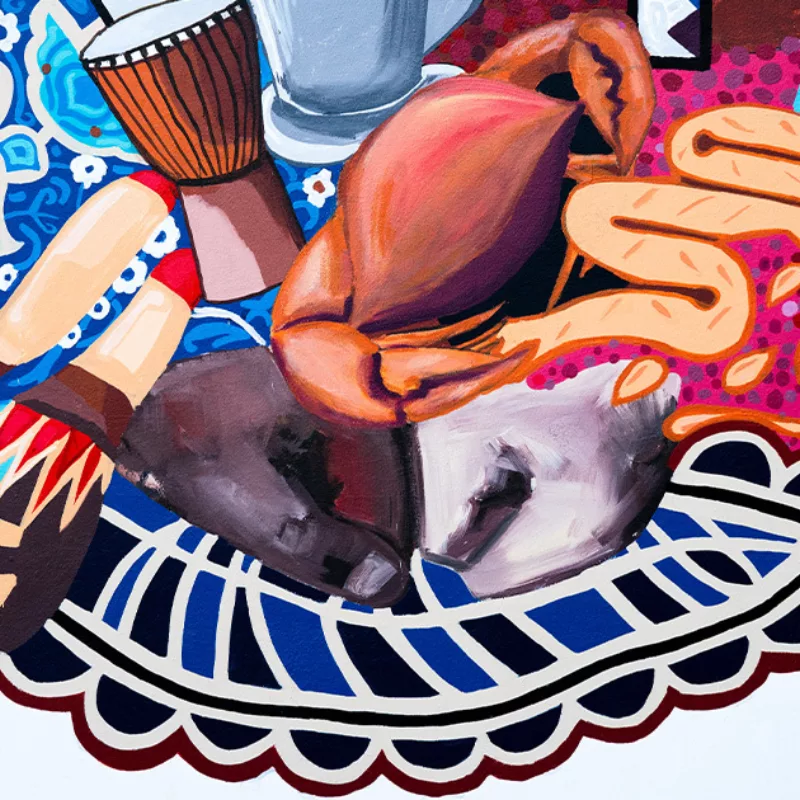
Moving down to the bottom, there’s a crab under the cup next to a double snake shape with an earthy red in between. There’s a pair of rattle instruments, maracas, pointing towards the ground. Blue shades cascade down from the letter N. Small symbols in white, black and red stream down an elaborate combination of blues. In this section you may notice the angular shapes inside the rattle instruments also replicated in the white and black angles around the N and the U. Moving to the right, there are two fists bumping together like a multicultural greeting. They are over a shape that may evoke a caterpillar or millipede with semi circular ends. The signature of Nick Zafir, the artist, is on the white surface of the wall on top of this shape which is also next to the double snake with an earthy red in between.
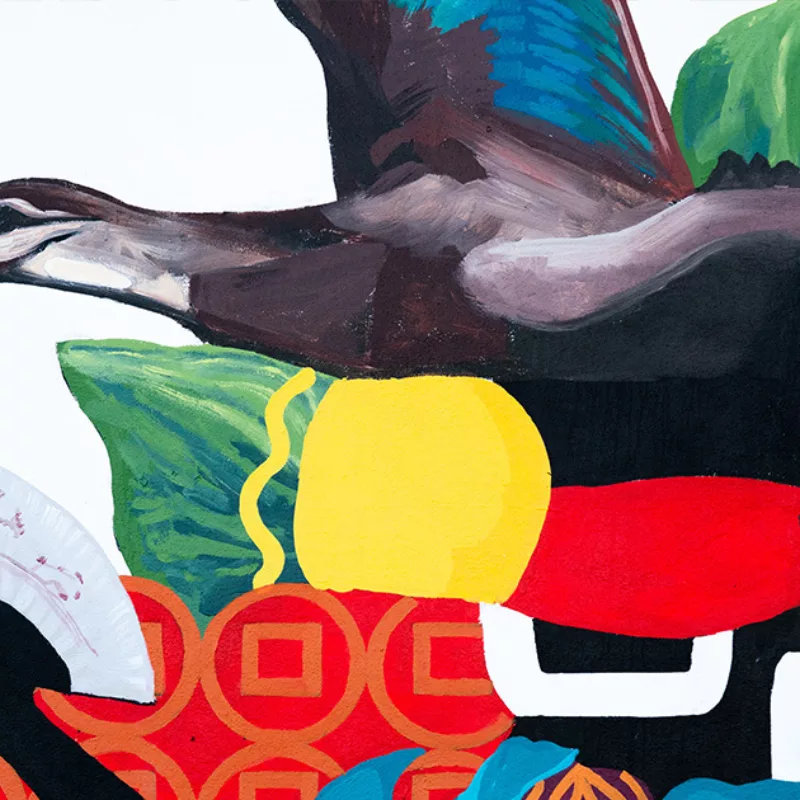
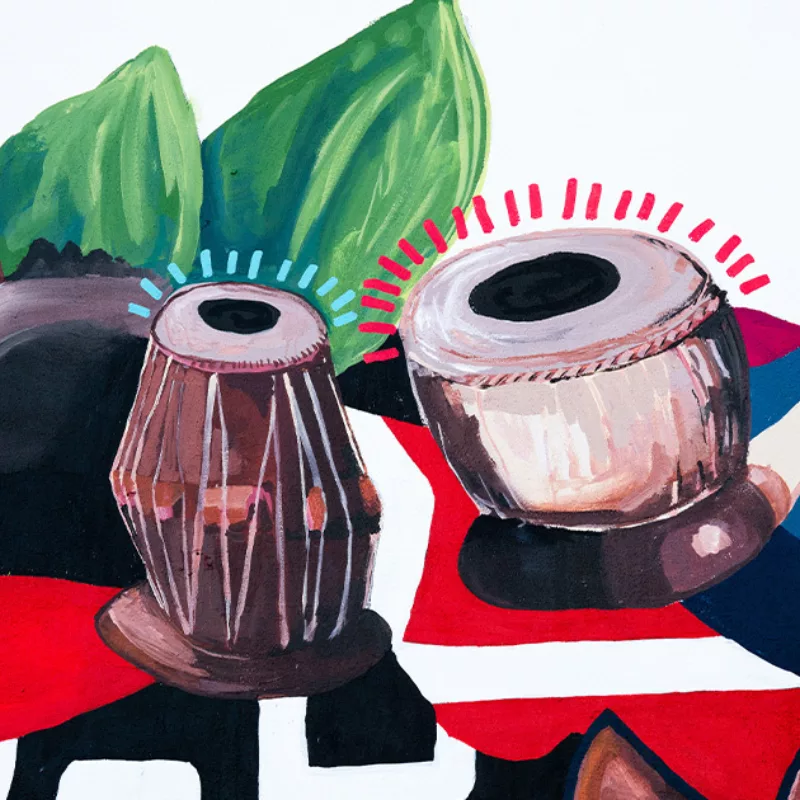
Moving further up there are two percussion instruments, three wide green leaves and a pacific black duck in full flight. One of its wings is opened fully and reaches the top of the mural. It has iridescent blue feathers. One of the green leaves is under the body of the duck and leads to a yellow sun with red and black resembling the Australian Aboriginal flag. Moving down, there are portions of white and black rectangular shapes next to golden encircled squares on a red background. A long black rectangular shape extends like an arm from a stream of blue shades. It is holding a mostly white semicircular fan with grey shades fanning out in line with the bright yellow sun. Zooming out of the mural, most of the images are fully contained within a circular composition with some elements extending into the outer white wall all around.
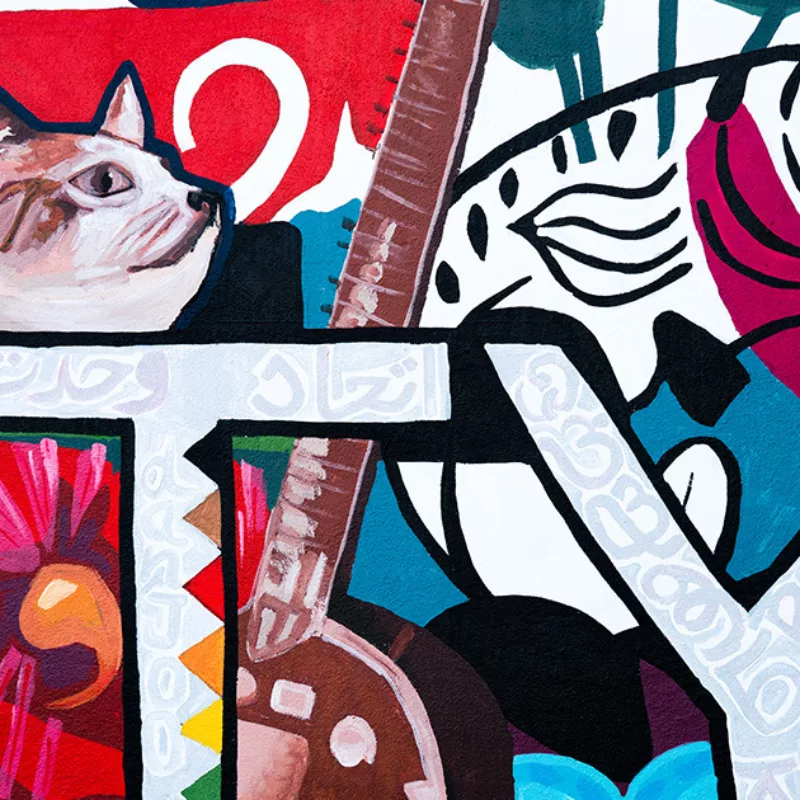
Let’s move back up to the word UNITY and follow it to the top of the mural. Little triangular flags in every colour of the rainbow run along the spine of the letter T. A cat pokes its head above the letter T. There’s a red flower and a plucked string instrument resembling a sitar on each side of the T. A fish is on top of the letter Y. The fish bones join up with a line of trees. Moving upwards, there are two partly covered shapes that may evoke two feet, one may look like toes, the other is in a heel shape. And from a distance they may appear like an island archipelago.
Monday – Friday, 9am – 5pm
PO Box 7514 Cloisters Square WA 6850
King Street Arts Centre
Ground Floor
357–365 Murray Street
Perth WA 6000
08 9226 2422
admin@can.org.au
ABN: 72106364407
Copyright 2026 CAN