NEWS
From policy to practice: stories from the coalface of CACD
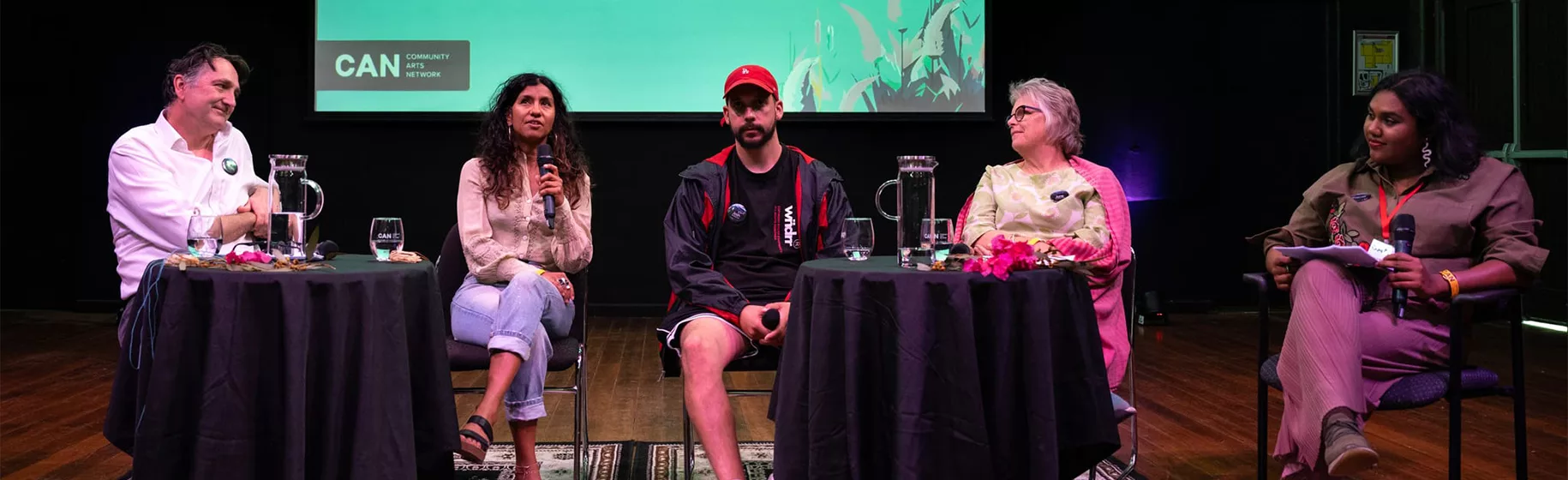

The Federal Government’s 2023 national cultural policy, Revive, sets a bold vision for the trajectory of the arts in contemporary Australia over the next 5 years, and Community Arts and Cultural Development (CACD) is central to the vision.
But how is this shaping what’s happening on the ground?
The first panel discussion at CAN’s Making Time conference saw experienced CACD artists, producers and industry leaders come together to dive into this question.
Community Arts and Cultural Development (CACD) is at the heart of Australia’s latest national cultural policy.
It’s right there in the title of the document: Revive – A place for every story, a story for every place.
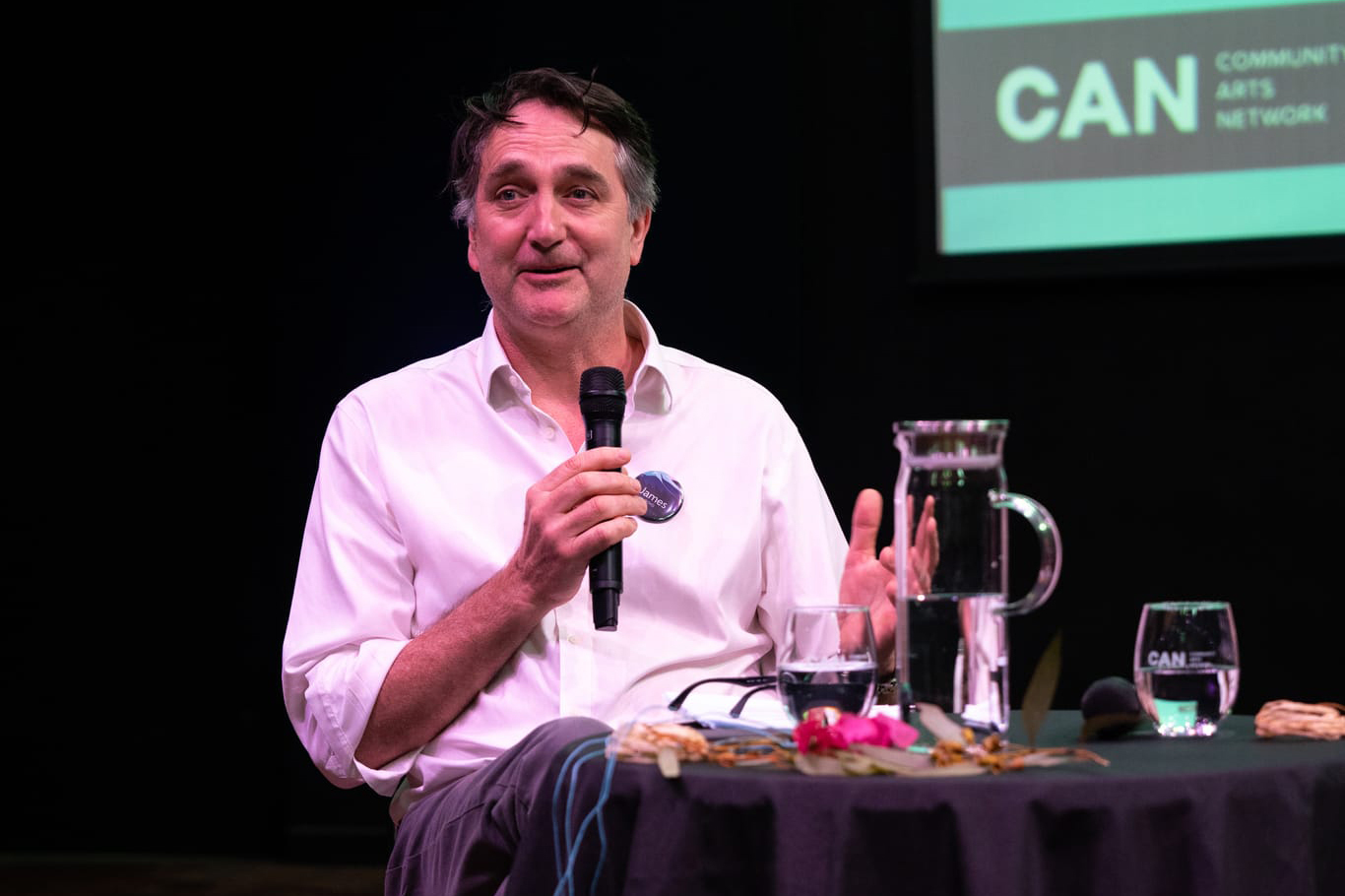
“Community Arts and Cultural Development is embedded into [the policy], in a depth I’ve never seen before,” observes James Boyd, who was appointed State Manager, Development and Partnerships WA at Creative Australia (formerly the Australia Council for the Arts) in July this year.
“I feel extremely optimistic regarding how a national cultural policy can strengthen Australian arts and cultural communities,” he continues.
“As a practice, CACD generates positive impact on the health and wellbeing of communities whilst stimulating artistic innovation and vibrancy. The five pillars that make up the policy reflect the important role of creative practitioners and communities in sharing their stories, and the public value this activity creates.”
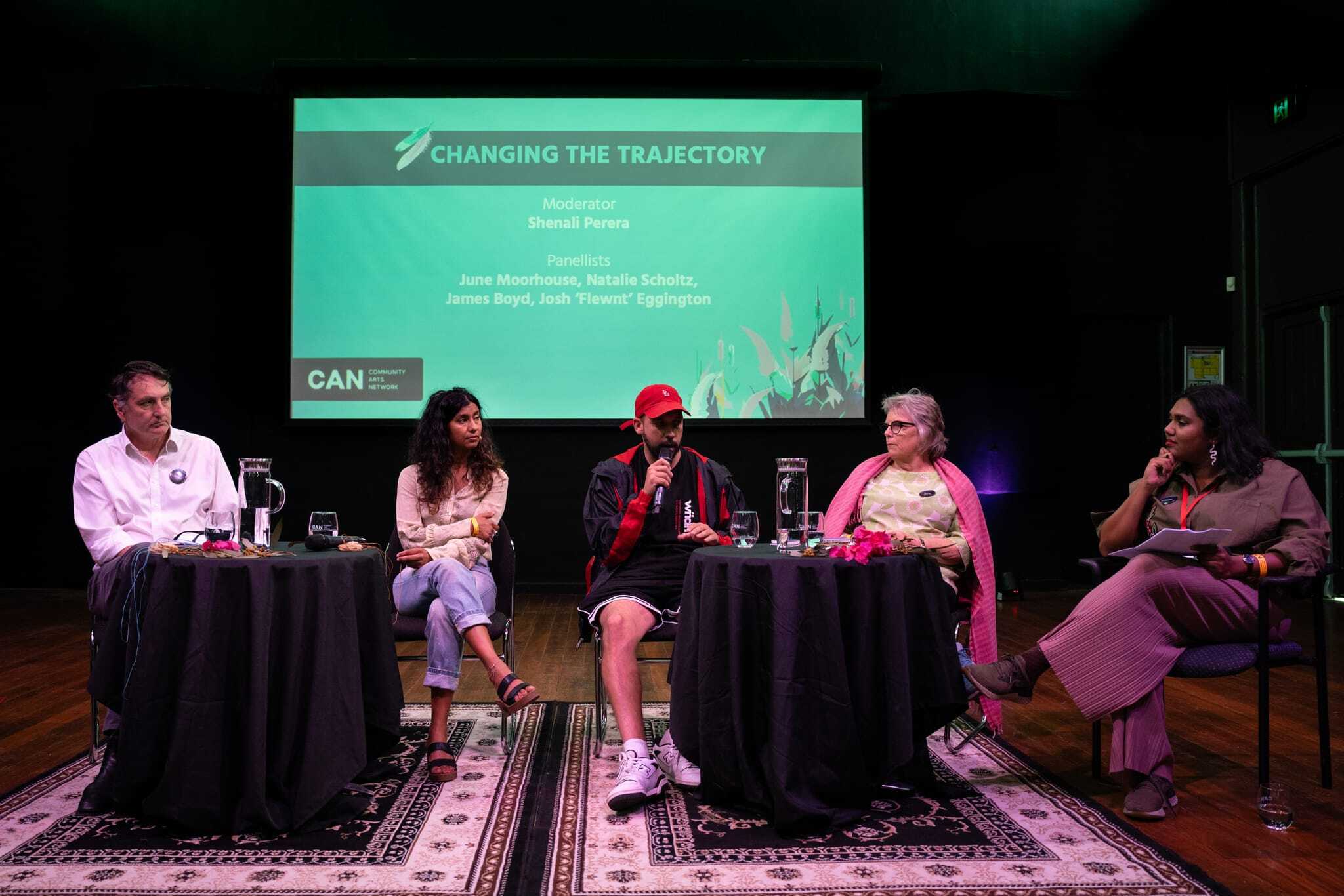
Boyd is speaking at “Changing the Trajectory”, a panel discussion exploring the place of CACD within this vision.
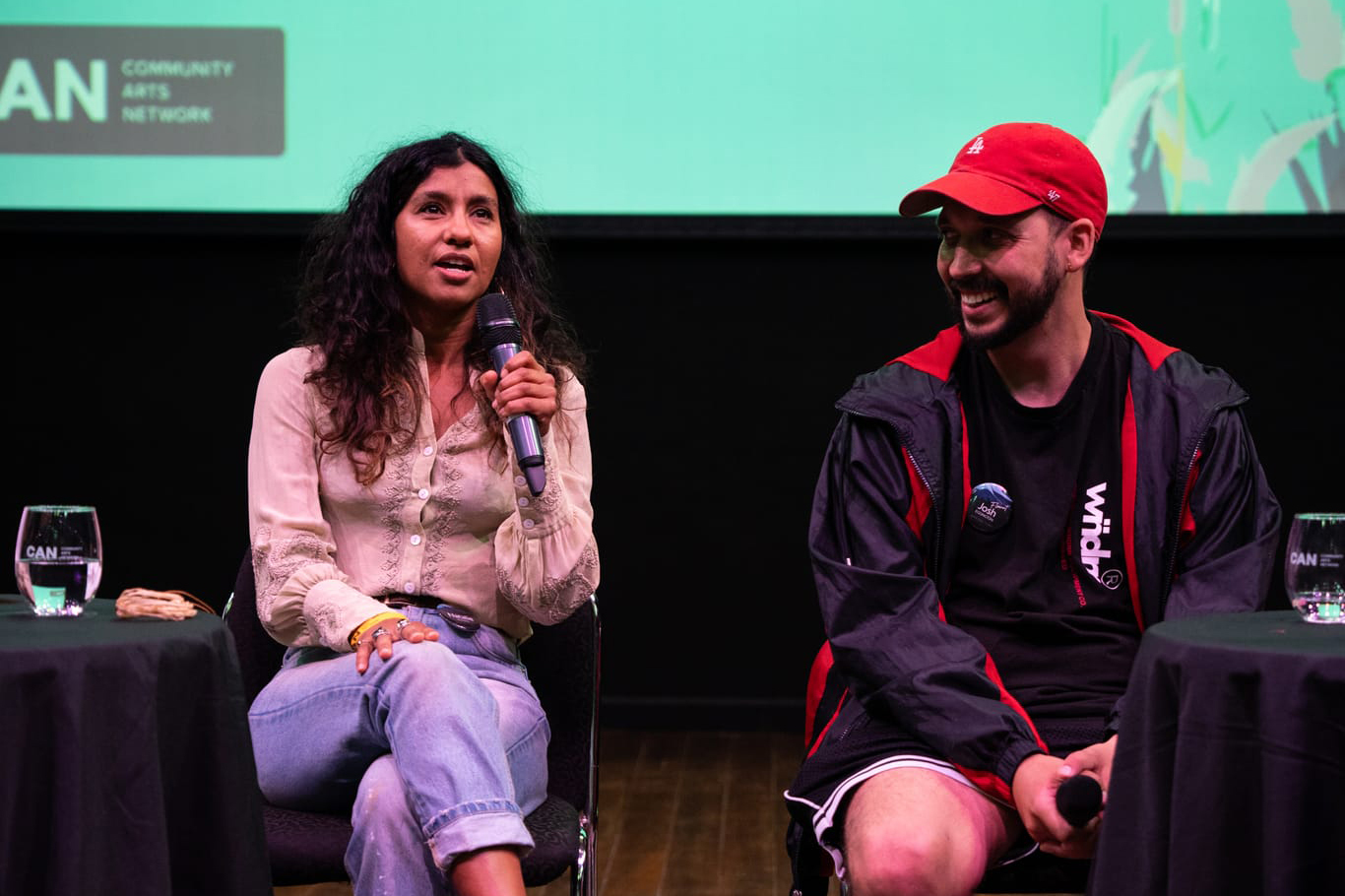
Moderated by artist Shenali Perera, Community Development Manager at CAN, the panel includes long-time CACD leader and Chair of the Chamber of Arts and Culture June Moorhouse, Noongar and Wongi hip-hop artist and youth worker Josh “Flewnt” Eggington, CACD artist and CAN Creative Producer Natalie Scholtz.
Jumping off from Boyd’s observation that CACD is embedded in national arts policy, Perera is keen to know “how it feels on the ground”, for those at the coalface.
In response Flewnt talks about his experiences as a youth worker.
“A lot of the work we do is around young people who have been highly traumatised, who have been in and out of justice systems or moved around from family,” he says. “These are recurring stories, especially when engaging with young First Nations mob”.
“So we go in with music as a way for them to be able to express themselves and speak about that. And it's in the way that we do it, it’s not like here, ‘Come here. sit down and write a song.’ It's about creating a space that they walk into, they become curious about.”
“You make it appealing. You have an area where there's heaps of cool stuff happening, it's laid back, there's nothing formal, it's just a place where a kid might pop their head in and be like, ‘Oh, what's going on there?’ And I'm like, ‘Hey, what's up, man?’”
“And then all of a sudden, we're yarning and they're starting to engage. We're trying to make space for young people to be able to fully tell their story, because they don't really get a chance anywhere else to have their voices heard.”
And these young people are hungry to be creative, says Flewnt.
“[Within the justice systems], the appetite for art is probably the highest… most young people want to go and be a part of it. It rivals sport.”
“Music … transforms and helps young people who are in some of the worst conditions that you can consider. The want for art is massive and not just music, the other art programs are high engagement as well.”
“When we travel around, young people come from all around, just to come, and be, and engage with our programs.”
As a CACD artist Natalie Scholtz feels that CACD artworks are not valued highly enough for their intrinsic worth.
“We want the billboards,” she says, “And it’s not because I want art to ‘win’. It’s because art is a tapestry in every society”.
“In Perth the pendulum of power is shifting – it is finally First Nations’ turn since a little while ago, and it has hit disability … and there are prolific artists [within these groups], along with cultural content and experiences out there. So get the good paints, the good canvas, blow it up in the digital realm – make it be heard. I think that perception is shifting, but it’s shifting slowly.”
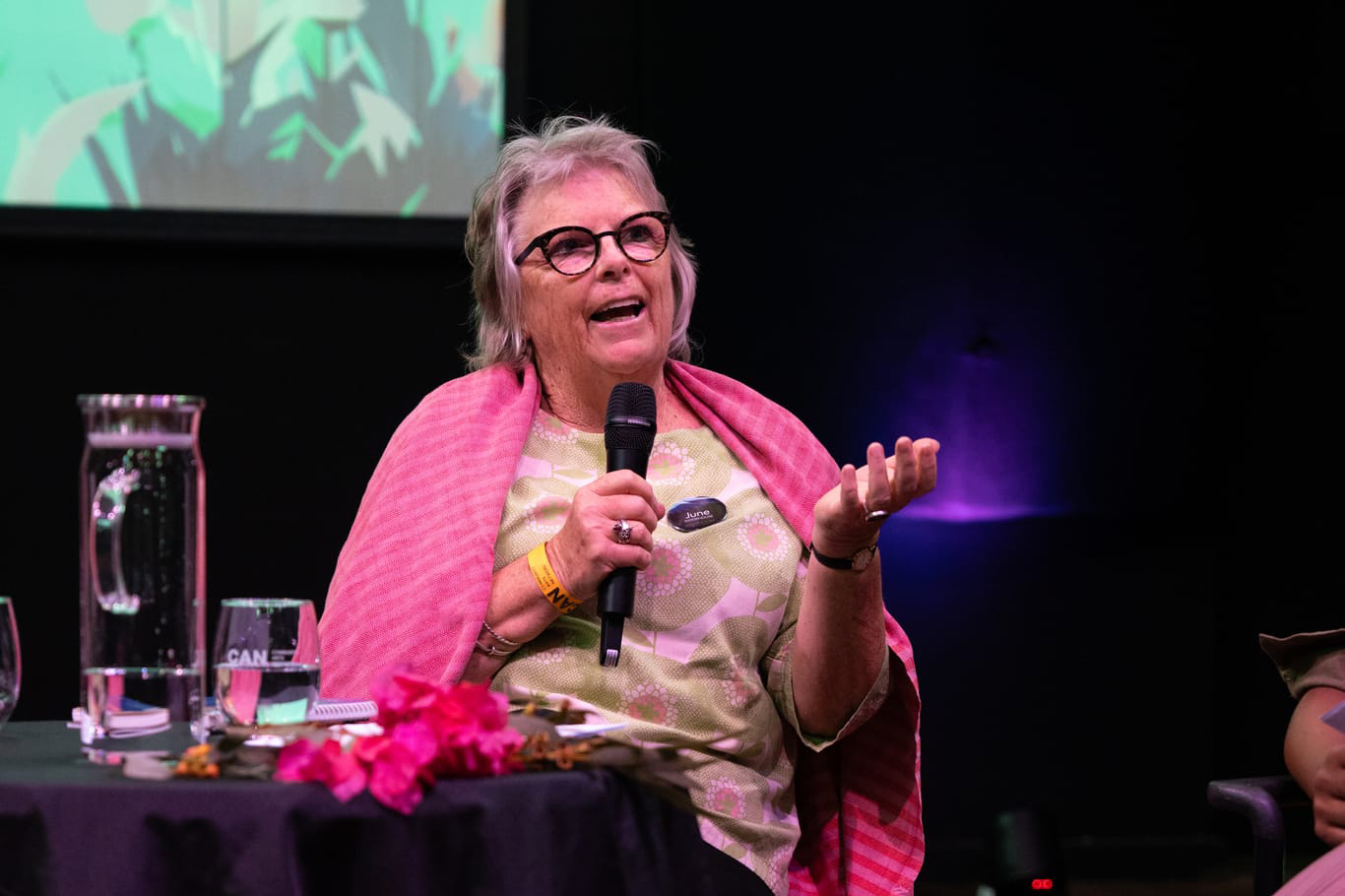
Like Scholtz, June Moorhouse is vocal about the artistic value of CACD. “This work has always been the most contemporary, cutting edge, innovative and important work that can happen in the arts,” she says, “because it deals with the here and now, and deals with where people are at.”
While she’s pleased to see CACD appearing at policy level, she has reservations around how that will play out in real life.
“CACD has become flavoursome from the top down,” she observes. “And the responses to that vary from people who approach it as a box-ticking exercise, to people who embrace the politics of the work with enthusiasm, who are gungho with little knowledge. And there’s great harm, potentially, in both those approaches.
“I want arts organisations to learn about CACD, and be curious about it, and to ask, ‘what is the depth of this work?’ Not, ‘how do I tick this box, because it’s part of a policy?’ but ‘How do I do this work?’
“CACD is about people’s lives. You don’t participate in a transformative practice, unless you’re on the journey of transformation yourself. If you’re working from a fixed position it’s not going to work. You’ve got to be on that journey with everyone who’s in the room with you. That’s the privilege of this work.”
That privilege, Scholtz says, keeps her coming back. “People trust you, they give you their stories. For me, that’s the cocaine of this industry.”
And sharing – of stories, of skills – with others is central to CACD, as Perera notes. “Community art is, by definition, collaborative. You can’t make a piece of community art by yourself.”
That often means navigating between different organisations and cultures. “Sometimes – and I’ve been in this position – you’re the middleman,” she says. “You’re the person who is translating for lots of different people.”
So Perera is keen to know – what are the tips and tricks for navigating that role?
“You don’t go in saying, ‘This is what we’re going to do.’ It’s always participant-led,” says Flewnt.
“I think that’s a big part of that initial engagement, that you aren’t trying to push something on participants. You’re trying to facilitate an experience for them, so that they can figure out their own outcomes.”
“I try to figure out what it is about me that I can connect with them. What are the things that make us the same? Or what is it that is interesting to you about me, and to me about you?”
“It’s important, too, to collaborate with artists you might connect with outside of the project”, continues Flewnt.
“That builds strong relationships, and a deep understanding of each other. And I always think that you should go back and work with people you’ve had great experiences with. I make conscious notes of who I’ve worked with well, who I think I give power to, and they give it to me.”
Moorhouse feels similarly. “When you do something human with a great sense of confidence there’s people who will freeze and there’s people who will open and move with you. You keep working with the ones who go, ‘Yep’. The people I want to work with are the ones who give me an ‘aah’ moment.”
For Scholtz it’s all about trust. “That takes a really long time,” she says, “which in our society, sadly, equates to money. And I think one of the key ingredients for trust is transparency.”

When Perera asks about the challenges of collaboration, Scholtz returns to that issue of time.
“There’s not enough time, full stop,” she says. “As a society we’re quite individualistic. And individuals love to equate time with money. But there’s some sort of a dissonance, then, with the nature of what community arts is. We want to sit and make time, to have relationships, to fall in love with a stranger, to hold a story, to be vulnerable. And that will sometimes get swallowed up by the outcome.”
Flewnt shares his concerns.
“Outcomes don’t make artists,” he states. “It’s the journey and the experience to the outcome that makes an artist. Don’t get me wrong – outcomes are dope. But it’s about the journey.”
“And if we're trying to nurture the next generation of artists and all these different young people that are creative, the focus has to be on the experience.”
Perera’s final question to the panel is, “How do you balance the governance, and structural things to keep people safe, with being creative and taking risks?
Safety is baked into the Revive: National Arts Policy. “Creative Australia promotes fair, safe and respectful workplaces for Australian artists and arts workers,” says Boyd. “This is a significant initiative currently being established, titled Creative Workplaces, from the new National Cultural Policy, and one that should be widely embraced across the industry.”
But creativity must be the driver of the arts, he says.
“I think it's so important that vision, a compelling idea, risk, all comes first. Governance is important, but it can follow.”
“Collaboration needs leadership, someone to drive it. That can be from community level, it doesn’t have to be from state government, federal government. Don’t wait, lead… government will follow. They’re looking for passionate people.”
“Changing the Trajectory” was presented as part of Making Time 2023, a day-long conference of creativity and conversation around arts, culture and transformation, presented by Community Arts Network.


Monday – Friday, 9am – 5pm
PO Box 7514 Cloisters Square WA 6850
King Street Arts Centre
Ground Floor
357–365 Murray Street
Perth WA 6000
08 9226 2422
admin@can.org.au
ABN: 72106364407
Copyright 2026 CAN