NEWS
From power balances to censorship: diving into collaboration
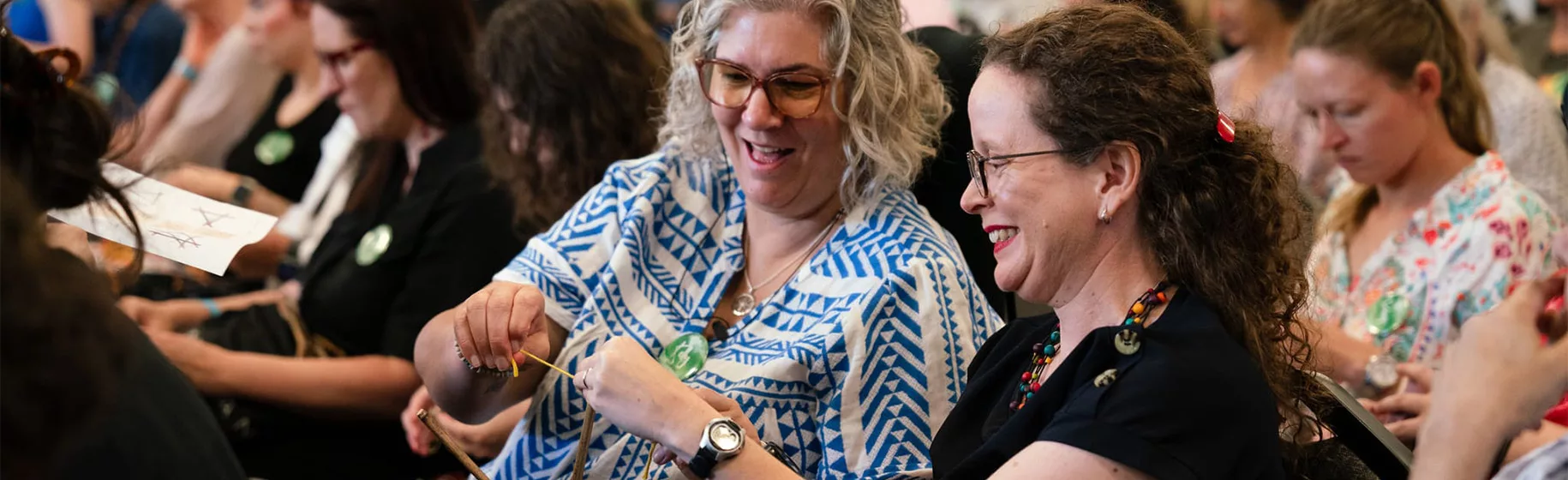
Power imbalances and censorship were just some of the hot button topics covered during Making Time’s panel discussions about the joys and challenges of collaboration.
Collaboration lies at the heart of our work as community arts and cultural development practitioners. That’s why we chose the theme Stronger Together for CAN’s 2024 Making Time conference.
It turned out to be a timely theme – just weeks after Making Time, the Department of Local Government, Sport and Cultural Industries (DLGSC) released Creative WA, its 10 year vision for culture and the arts in Western Australia. One of the policy’s three guiding principles is “a partnership approach to collaborate with others”.
Over two panel conversations we took a deep dive into the nature of creative collaboration. In the first we explored how we can navigate the fine line between competition and collaboration, and the second discussed the ways in which we can pool our creative powers to make social and political change.
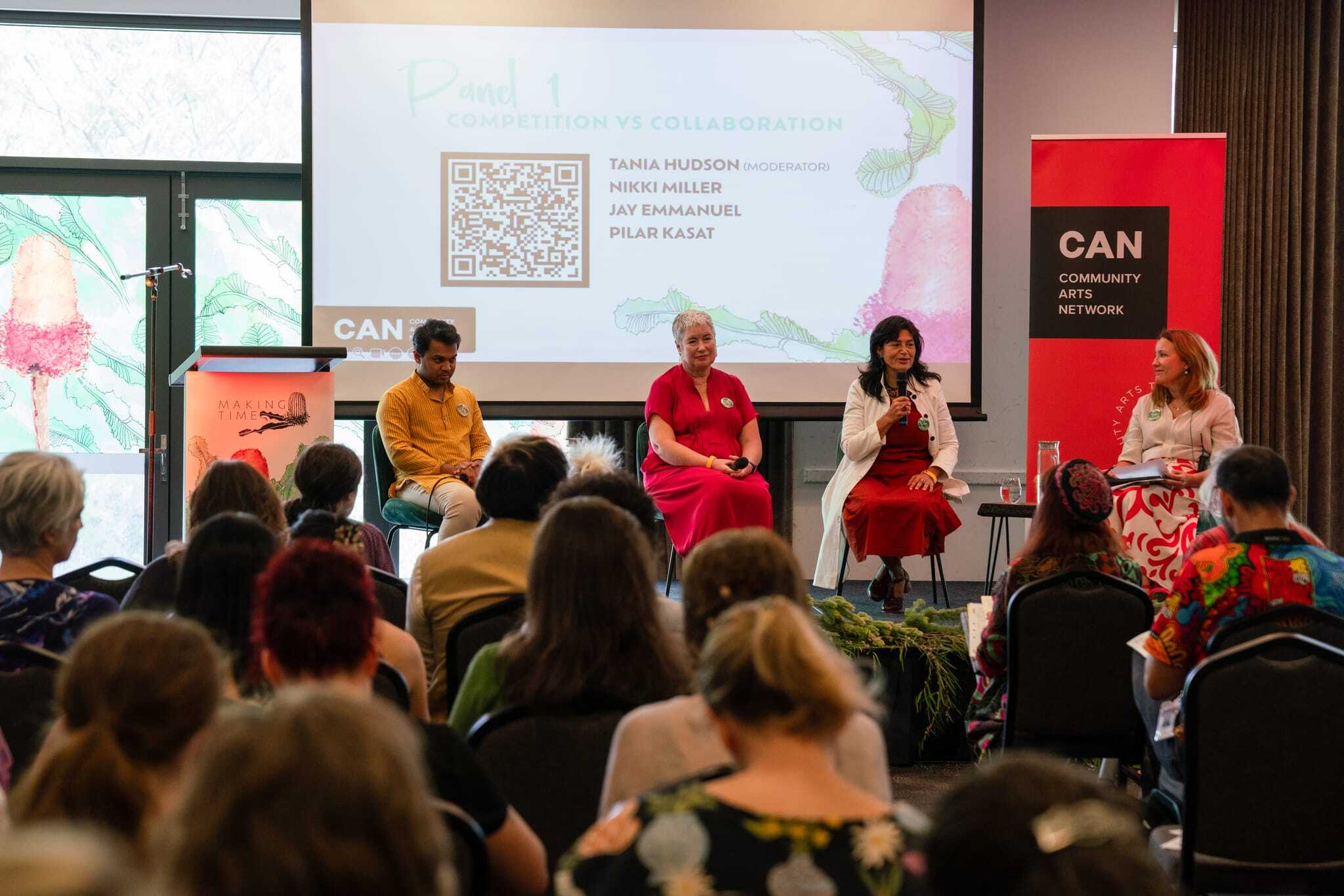
Moderated by Tania Hudson (Chamber of Arts and Culture), the first panel, Competition vs Collaboration saw panellists Pilar Kasat (Regional Arts WA), Nikki Miller (DLGSC) and Jay Emmanuel (Encounter Theatre) provide frank discussion and practical advice about collaborating in a climate where we are often competing for the same limited resources.
Of the many challenges to collaboration identified by the panel, perhaps the most significant is power imbalances. “These competitions and collaborations don’t happen in a vacuum,” pointed out Pilar Kasat. “They’re happening in structures… where some people have more power than others, especially around resources. Those who control the resources control the power, and often the agenda.”
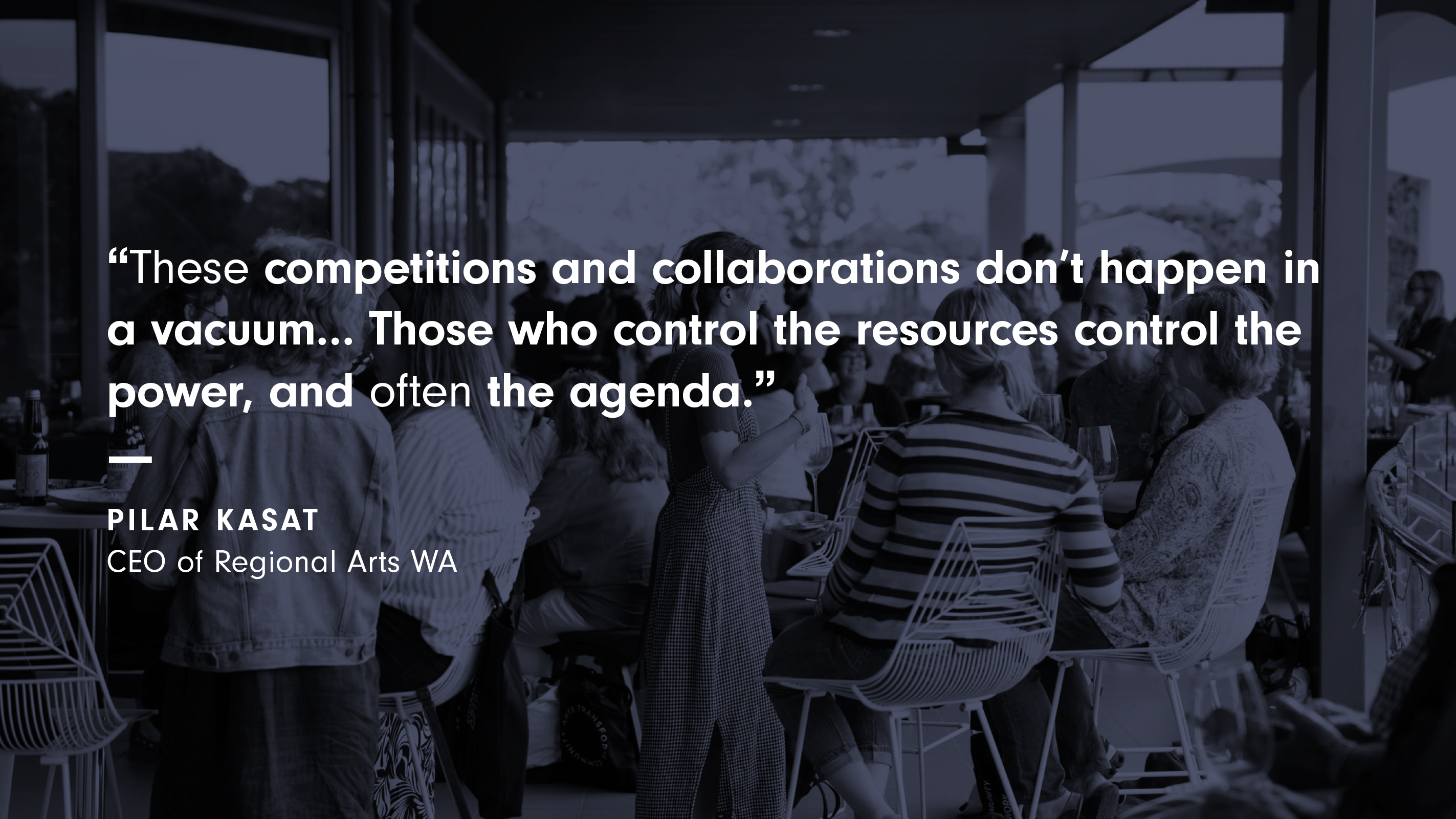
Background image by Edwin Sitt
Another notable challenge, said Nikki Miller, is embedding collaboration in organisations. “So often it’s personality-based, two people leading something. It’s so much more powerful if there's an organisational wish, a whole team working together, because if it only comes from the top and those people leave it falls apart or it might be a collaboration in name only.”
Encouragingly, the conversation around how to foster collaboration was just as lively, with many suggestions from the panel around building trust and having deep conversations, including this, from Jay Emmanuel:
“Knowing your own worth, what you’re bringing to the table is also necessary for collaboration to happen,” he says. “You are not just you. You are your ancestors, your community. Keeping this in the back of my head has helped me to clarify, if this relationship going to do justice, not just to me or the art, but to my community.”
Jay also offered a practical example of collaboration – both locally and internationally – from his own company, Encounter. Realising that there is a shortage of cultural leaders in WA from CaLD and First Nations backgrounds, but acknowledging that they did not have the capacity to address this issue alone, Encounter looked to a model from Canadian company Why Not Theatre. Encounter is now collaborating with Black Swan Theatre Company, The Blue Room Theatre, Perth Festival, Performing Lines WA and Contemporary Asian Australian Performance to present a program called This Gen Fellowship, which offers three directors and three producers from CaLD and First Nations backgrounds a 12 month paid fellowship.
Edwin Sitt
(L–R) Jay Emmanuel, Nikki Miller, Pilar Kasat and Tania Hudson provided frank discussion and practical advice about collaborating in a climate where we are often competing for the same limited resources.
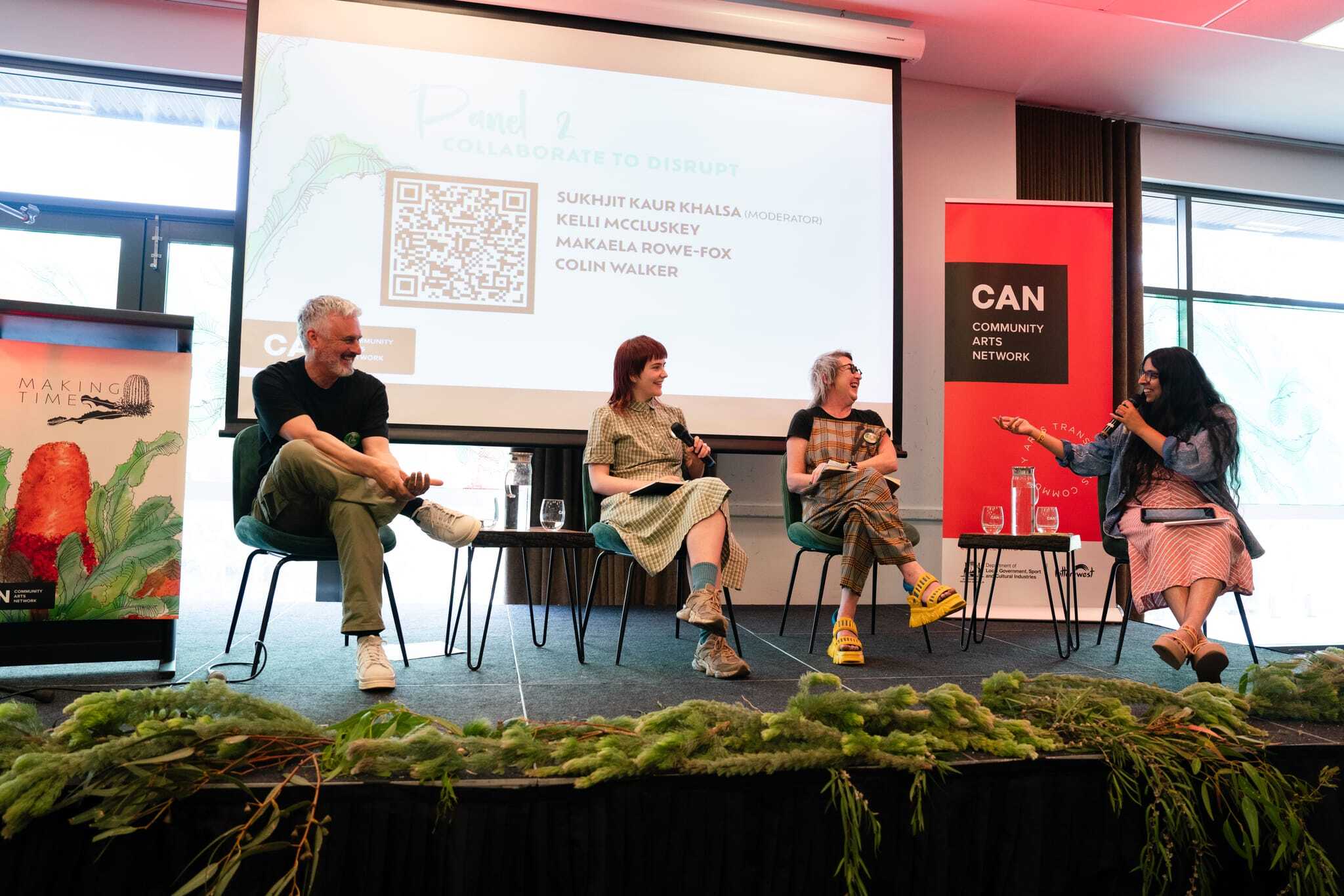
This practical example, alongside other talking points, formed a kind of unplanned segue into the second panel discussion, Collaborate to Disrupt, in which moderator Sukhjit Kaur Khalsa (The Blue Room Theatre/Independent artist and writer) and panellists Kelli McCluskey (pvi collective), Makaela Rowe-Fox (independent artist) and Colin Walker (Art Gallery of WA) explored how artists and arts workers might work together to effect social and political change.
Like the first panel, this discussion was filled with ideas and real-world examples. A conversation about the challenges of getting coverage in mainstream media, and the reasons for that, led Sukhjit to ask the panel if they think Australian arts organisations/funders/institutions censor artists and initiatives.
Makaela Rowe-Fox responded emphatically, yes. “Censorship is happening in WA because many of our arts orgs are being funded by the big money that seeks to maintain business as usual during the climate crisis, and it is this big money that continues to profit from ongoing colonial projects here in Australia and in conflicts around the world." she said. "I think that in the arts, when we're drawing attention to these power structures, we're challenging this big money, and that's really threatening. And I think that's why we're seeing works get censored, and artists.”
Kelli McCluskey suggested that censorship is more covert. “It's the interviews you don't get, it's the platforms you don't get to speak on, it's the conversations you don't get to have,” she said. “So it's actually a lot more insidious, I would say, than just a straightforward, ‘This has been censored.’”
Colin Walker offered another perspective: while artists may not be explicitly censored, their work is – consciously or otherwise – shaped by the values of commercial sponsors. “You change your behaviour in some way to meet an expectation, whether said or unsaid,” he remarked.
Background image by Edwin Sitt
In spite of this fairly dire-sounding context, the tone of the conversation about how we can collaborate to make change was optimistic.
A through-line for Makaela was that the distinction between art and activism needs to underpin any conversation about how we can collaborate to make change. “Art is not activism, it is not direct action,” she explained. “We can't be making art that is political without also engaging in politics in a lived way ourselves. As a community, I think we need to come together and engage in direct action but we don't need to start our own movements. There are plenty of amazing movements already happening that we can join.”
Underpinning Colin’s contributions to the conversation was his belief in the importance of more subtle action that targets the general public rather than decision-makers, “because its members of the public who ultimately vote politicians in or out,” he said.
“To properly disrupt you need nuance and balance. Your message has to be imbued, with humour, or with either direct action or a little bit more soul. It's got to have personality attached to it, because people engage with that.”
Edwin Sitt
In spite of a fairly dire-sounding context, the tone of the panel's conversation about how we can collaborate to make change was optimistic. Pictured (L–R) Collin Waker, Makaela Rowe-Fox, Kelli McCluskey and Sukhjit Kaur Khalsa
A highlight of the discussion was Kelli’s impassioned call for artists and arts workers to come together to campaign for a living wage for artists. She argued that the current funding model, for independent artists in particular, locks them into “a lifetime of uncertainty”, one that causes both financial and psychological distress, according to a recent study by Swinburne University.
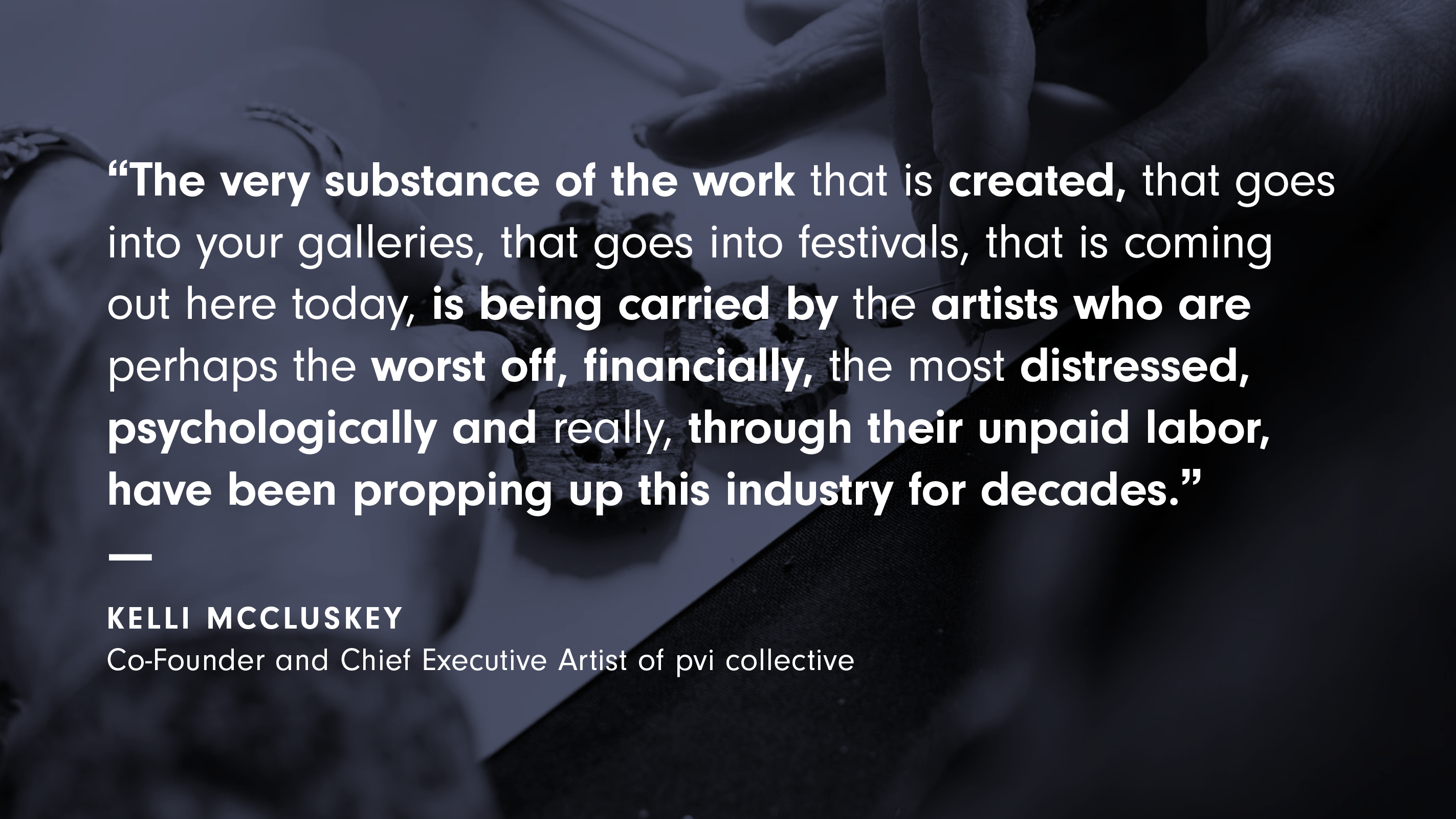
“The very substance of the work that is created, that goes into your galleries, that goes into festivals, that is coming out here today, is being carried by the artists who are perhaps the worst off, financially, the most distressed, psychologically and really, through their unpaid labor, have been propping up this industry for decades,” she elaborated. “And so I feel as though a basic income for artists should not be a radical proposition. So that's what I'd be keen for us to come together on.”
With both panels running for an hour, this is just a sample of the rich discussions that each offered. If you missed out on a ticket to 2024’s edition of Making Time – which also included hands-on creative workshops and networking opportunities – stay tuned as we’ll be presenting the next iteration in November.
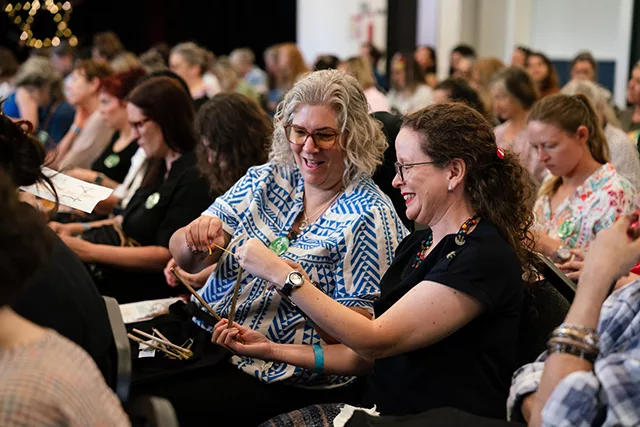
Pictured top: Audience members participating in creating a collaborative temporary installation, led by artist Sandy McKendrick, while they listen to the first panel // credit Edwin Sitt


Monday – Friday, 9am – 5pm
PO Box 7514 Cloisters Square WA 6850
King Street Arts Centre
Ground Floor
357–365 Murray Street
Perth WA 6000
08 9226 2422
admin@can.org.au
ABN: 72106364407
Copyright 2026 CAN