NEWS
Creativity off the clock
If you’re an artist you probably have another occupation, to keep you fed, clothed and sheltered. Often such jobs are found in arts organisations, places that require and value the creative thinking that artists bring to the table.
But how do you make space for your own creative practice when your time and energy is also being directed into the creative vision of others?
Nina Levy spoke to three artists about the challenges and rewards of balancing your own creative practice with work in the creative industries.
The vast majority of artists have day-jobs and it’s fairly common for artists to find those jobs within the arts sector. But working for an arts organisation or institution is notoriously demanding of one’s creative energy – how does an artist find time and energy for their own practice?
“I think that's a great question that artists need to solve,” says Dr Shona Erskine, who speaks not just from personal experience as a dance artist and a parent of two teens, but as a psychologist with expertise in creativity and performance. “The solving of this problem is a process in and of itself, because it's going to look different at different parts of your life.
“As a young artist I did a lot of teaching dance in universities, because that was a regular and fairly well paid position that ran for 20 or 25 weeks of the year. And it allowed me to still be connected to my body and to the thinking and stuff. But it also made me really sore and really tired. And I had to juggle the commitment of that with [performance] contracts that came up. So it created its own kind of drama.
“One of the things that I did was I paid myself forward. By doing a psychology qualification, taking on something that wasn't quick – it was a 10 year academic slog – I've paid myself into the future, and I'm now in that future.
“So I think that the answer is so dependent on the individual and what phase they're at in their artistic life.”
Artist and visual scribe Shenali Perera believes that the all-encompassing nature of being a visual scribe makes it well suited to balancing with her position of Community Development Manager at Community Arts Network.
Visual scribing or graphic recording is a practice in which a talk, discussion or presentation is mapped out visually by an artist, creating a pictorial representation of what is being discussed, live and in the moment.
“Scribing is almost like a performance in that you have to be completely present,” says Perera. “So when I'm booked for a scribing gig, I have to take time off from work. I don't have my phone, everything is switched off and I'm fully present in the moment and in what I'm doing. I find that incredibly liberating – almost cathartic – and such a great break from the other spaces that I inhabit.”
Carol Millner, a writer, poet and mother of two young adults and one teen, was appointed General Manager at Sensorium Theatre in April 2022. While she found that her previous day job, teaching writing at universities, aligned relatively easily with her own writing practice, she says finding space for her creative practice alongside her current role is more challenging.
“General managers are tasked with enabling. It's a sort of midwifery role,” she explains. “My company is very generous and they do acknowledge that I'm a creative as well. But I still struggle with that – I'm trying to keep a lid on [my creative side] all day every day …. And I think that is quite inhibiting, when I try and switch to the other brain. I get to a piece of time that I could be using creatively and I'm quite depleted.”
It’s challenging but Millner has a number of strategies to transition into that creative zone.
“I schedule writing retreats, residencies,” she says. “I had two last year; one was in Bali, and we had to write 2000 new words before noon every day. That reminded me that actually I can get 2000 words done, and it doesn’t matter if it’s crafted or not because you can come back to it later.”
For the ordinary day-to-day, Millner says it’s about being realistic about what’s possible.
“I try and carve out a little bit of time for creativity every day, whether it's half an hour or an hour and a half,” she says.
That idea, of setting an achievable goal, is helpful for those who are pressed for time, says Erskine. And while it may sound counterintuitive, her first tip is not to rush.
“Doing something creative with your own form, your own body, your own mind, your own hands, is going to take a whole lot of resources,” she says. “We’re surrounded by 5 second TikToks, that show things being transformed really quickly, but it's actually best to do it super, super slow.”
This is especially true if you’re returning to your creative practice after a break or life-change Erskine continues.
“If you're out of practice, choose a task that's so small, you're 100% guaranteed to be able to do it. Our attentional capacities wane when we don't use them. Our skill level drops. And there's probably a reason why you're not doing it, a pressure, you're trying to squeeze it in amongst work, or it's costing you something, like we're having baked beans on toast tonight because Mum wants to make something.
“So I would say just go small. Don’t get caught up in big.”

Orien Harvey Photography
Shona Erskine
Perera has chosen to set aside time within the working week for her creative practice.
“I work at CAN 4 days a week,” she says. “So whether I have scribing work or not, I always have one day of the week that is just my own practice day. And I've gotten better at not guilting myself for needing time to prepare before and rest after a scribing gig, and including that in what I book out in terms of time.”
While Millner works in her day job full-time, she is strategic about how she manages her energy levels. “I try to make Friday a 75% day,” she says. “It's a catch up day, all the things I didn't get to during the week. It's not a day for new business unless I absolutely have to. And I try and work from home that day … because if I can get off that work wave a little bit more completely by the end of day Friday, then I can walk into my weekend with time for me.”
Perera also pays attention to managing energy levels. “I love being creative in all aspects of my life; I love cooking, I love dressing myself in the morning, I love creative conversations with friends. So it feels really natural to do that in work as well. I think there is an abundance of creativity that is always accessible to me.
“But if I'm doing too much, whether it's creative or not, then I don't have access to that abundance, because I need rest.”
At times Perera’s work at CAN involves working intensively, particularly when she’s producing an artistic residency in a regional area. In order to maintain her own creative work and also look after her physical and mental health, she has to think ahead.
“I try to map out those periods of high intensity, before my year starts, or my month starts. And then – especially with the creative practice – it’s really useful not to have two [high intensity] things happening at the same time,” she says. “But what I've also found quite positive is to have a scribing gig right after I've been away on a residency because it allows me to completely detach from my producer brain, and just be in the scribing space.”
Right now Millner says she can find the time and energy for writing, but not necessarily for the administration that is involved in getting that writing published.
“I don't want to waste time sending things to competitions or publishers, because that's time I could actually be producing,” she says. “That's quite annoying because you're only as good as the last thing you had published.”
While this worries her, she’s trying to reframe the way she thinks about her creative process.
“I'm having a conversation with myself at the moment around the idea that, actually, the best work is the work that you make in service to your own aesthetic. So it doesn't matter if it's being published at the moment or not,” she says.
“There's different seasons to a creative life and right now, I'm not in a ‘putting out very much’ season. It's like a winter season, I'm hunkering down and reading and writing and journalling and absorbing and thinking, rather than sending off a finished product.”
In psychological terms this idea of having different phases or seasons of creative practice has a name: “conscious imbalance”. Erskine believes it’s a game-changer for artists.
“The concept of conscious imbalance is counter to the work/life balance idea,” she says. “What it means is that you've identified that there are domains in your life that are important to you. So if you’re an artist and also a producer, one domain might be your artistry, another might be your producing, or another might just be money-earning, if you have kids another would be parenting.
“The idea here is that you make a conscious decision which domain you're going to stand in, and you accept that the other domains are going to suffer.”
Instead of trying to “do it all”, conscious imbalance is about accepting that if you’re prioritising one domain, the others will have less of your time. And it’s not static, explains Erskine. At one point in your life, creativity might be your priority, at another, earning money, at another, looking after children.
Looking back, Erskine says she has practised conscious imbalance all her life. “But I struggled with it,” she says. “When actually, if someone had just explained to me that, you just make a choice, and you accept it, it would have just been so much easier to see that swing over the course of a year or many years.”
Practising conscious imbalance isn’t an all-or-nothing proposition, says Erskine. Just as Millner is using her “winter season” to focus on process rather than product, it’s possible to find ways to keep your creative ideas bubbling when your priorities are elsewhere.
“Say you’re working as a producer,” says Erskine, “you might have a book that sits on the side where you write down all your great ideas. And when it's time to readjust the balance, then you can go back to that.
“But trying to do it all at once? You’re just going to fry your nervous system.”
That idea of keeping a book for ideas chimes with me. I’ve been a professional arts writer for 16 years. During that time I’ve dipped my toes into developing my own practice in creative non-fiction but I haven’t been able to find a way to make it a regular commitment because so much of my time is already spent writing.
But just last week I was swimming at the beach when words began bobbing to the surface of my mind as though made buoyant by the saltwater. When I returned to my towel I kicked myself for not bringing a notebook… but then I remembered the notes app on my phone. Soon I was tapping away, getting those thought bubbles down.
When I relate this story to Erskine, she encourages me to be open to those moments as a way of finding time, and finding a way to write that doesn’t involve sitting at my desk.
“If you are creatively minded, there are probably fissures all over the place,” she says. “Our brains sometimes go, well, that's not enough. But actually, completely is.”
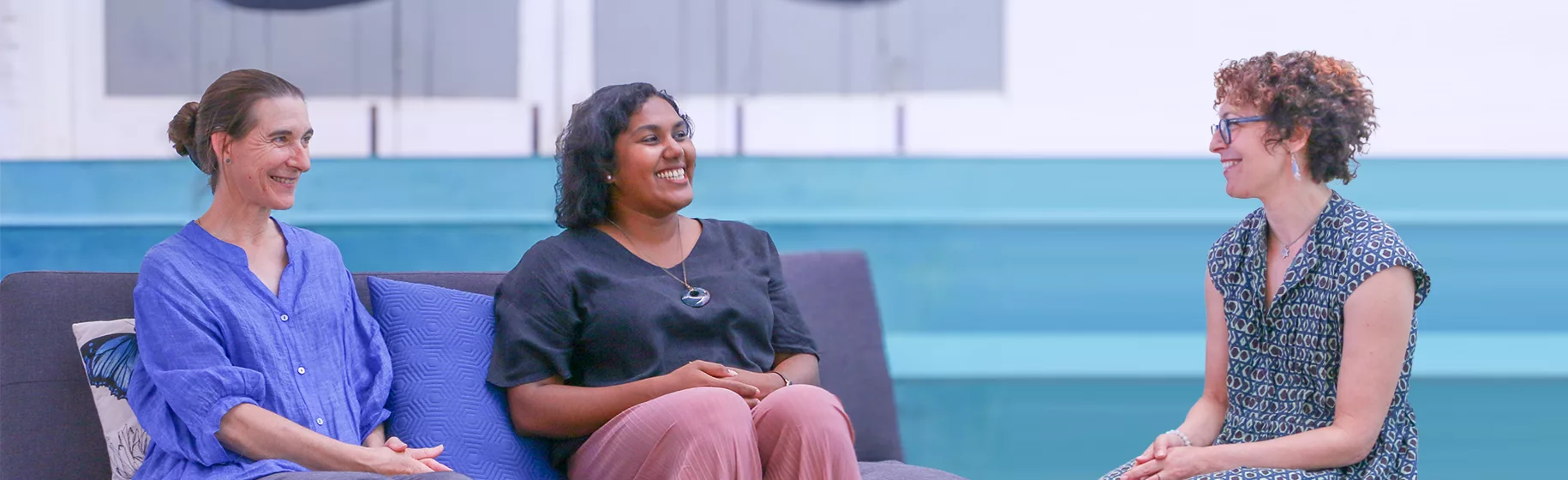
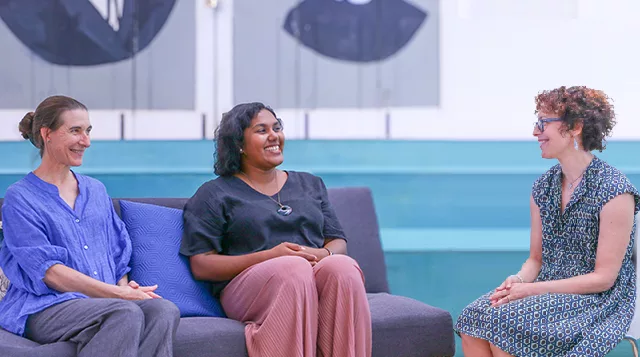
Top: (L–R) Sensorium's General Manager Carol Millner and CAN's Community Development Manager Shenali Perera and Communications Coordinator Nina Levy


Monday – Friday, 9am – 5pm
PO Box 7514 Cloisters Square WA 6850
King Street Arts Centre
Ground Floor
357–365 Murray Street
Perth WA 6000
08 9226 2422
admin@can.org.au
ABN: 72106364407
Copyright 2026 CAN